
Why Straight-Line Lifting Is Leaving Gains on the Table and Injury Risk on the Field
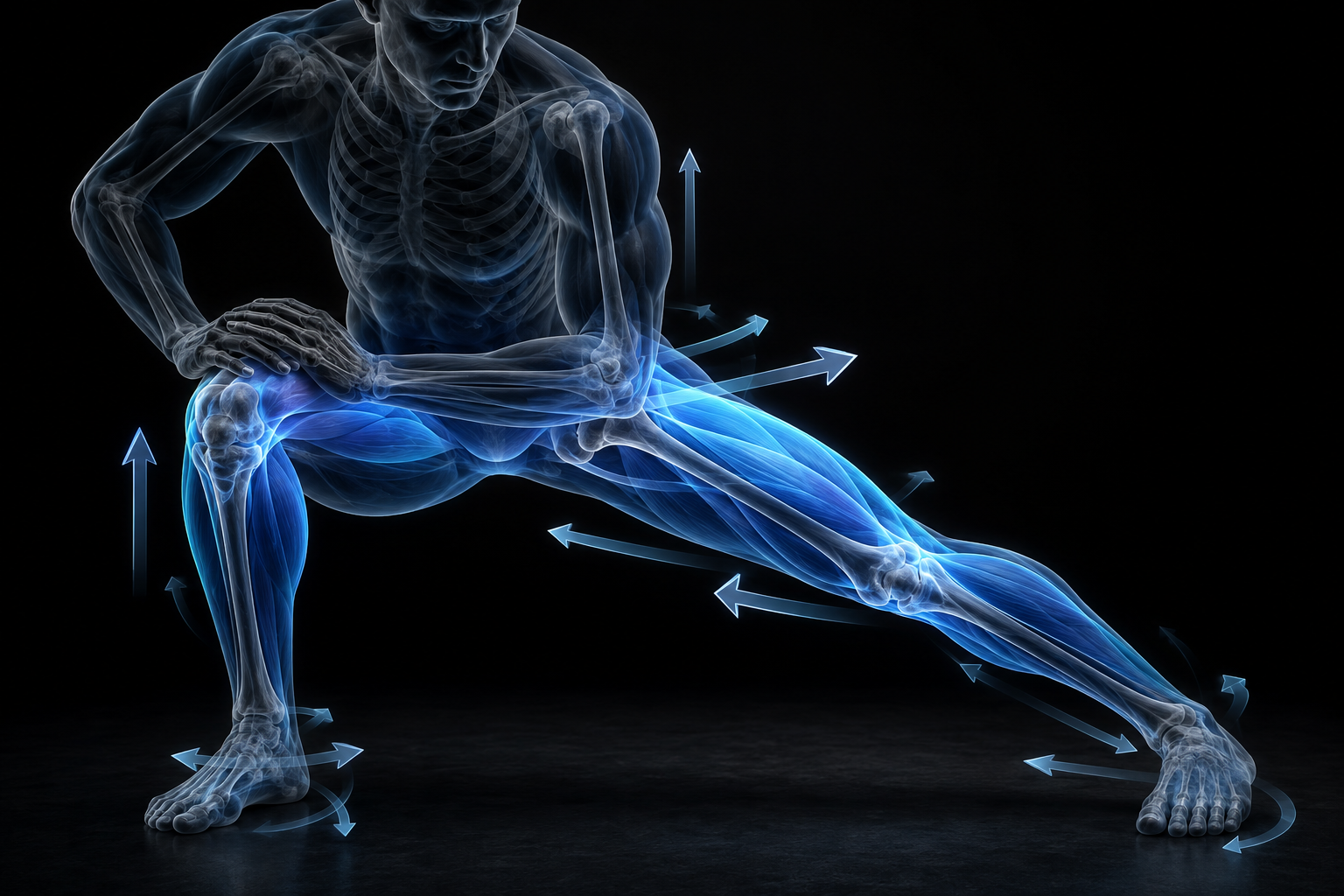
Most offseason strength programs are built around the same foundational movements: squats, deadlifts, bench press, Romanian deadlifts, rows. These are excellent exercises. They build a meaningful foundation of strength, and no serious program should abandon them. But they share one significant limitation: they train the body almost exclusively in the sagittal plane — forward and back, up and down — while the sports they're preparing athletes for demand force production and force absorption in all three planes simultaneously.
A peer-reviewed biomechanical analysis published in Clinical Biomechanics reached a conclusion that should reshape how offseason programs are designed: "Sagittal plane biomechanics cannot injure the ACL during sidestep cutting." The implication is direct. If the most common non-contact knee injury mechanism in multidirectional sport is driven by frontal and transverse plane loading — valgus collapse, hip internal rotation, tibial external rotation — then a program built almost entirely on sagittal plane strength is leaving the most injury-relevant plane of motion systematically undertrained.
At KRU Physical Therapy + Performance Lab, we work with athletes across football, basketball, soccer, volleyball, and a wide range of multidirectional sports. The athletes who carry the most durable strength into a season aren't always the ones who lifted the most weight in a straight line. They're the ones whose strength transfers to the demands of the sport — in all three planes it operates in.
01 | The Three Planes — and Why Most Programs Miss Two of Them
The human body moves in three anatomical planes simultaneously during athletic activity. Understanding what each plane demands from the body — and which injuries occur when those demands exceed an athlete's capacity — is the foundation for designing a program that actually prepares athletes for sport.
The Sagittal Plane: Where Most Training Lives
The sagittal plane divides the body into left and right halves. Movement in this plane involves flexion and extension — squatting, deadlifting, lunging forward, running in a straight line. The vast majority of conventional strength training occurs here. Squats, deadlifts, Romanian deadlifts, hip hinges, bench press, rows — all sagittal plane dominant. These movements are foundational and should remain in every program. But as the primary or exclusive training plane, they create a body that is strong in the direction it trains and systematically underprepared in the directions it doesn't.
The Frontal Plane: The Most Undertrained Plane in Sport
The frontal plane divides the body into front and back halves. Movement occurs side to side — lateral lunges, lateral shuffles, hip abduction and adduction, lateral bounds. This is the plane most responsible for change of direction, defensive sliding, cutting, and the ability to absorb lateral force without knee valgus collapse. Research published in the British Journal of Sports Medicine found that ACL injury prevention programs focusing only on sagittal plane landing mechanics are likely to be less effective because frontal and transverse plane loading mechanisms are significant contributors to non-contact ACL tears. For athletes in basketball, football, soccer, lacrosse, and any sport requiring lateral cutting, frontal plane strength is often the difference between absorbing a cut cleanly and the knee buckling inward.
The Transverse Plane: Where Power Is Generated and Rarely Trained
The transverse plane divides the body into top and bottom halves. Movement is rotational — twisting, pivoting, rotating through the trunk and hips. The transverse plane is where rotational power originates: the throwing motion, the batting swing, the hip rotation through a cut, the torque generated in a tackle. It's also where the most complex injury mechanics occur. Non-contact ACL injuries consistently involve a combination of knee valgus, hip internal rotation, and tibial external rotation — a multiplanar loading pattern that pure sagittal plane training does almost nothing to prepare the body for.
02 | What Happens When You Only Train in One Plane
Straight-line lifting builds straight-line strength. The problem is that sport rarely asks for it in isolation — and the gaps left by single-plane training show up predictably in injury patterns.
Muscle Imbalances That Build Over Time
Repetitive sagittal plane loading develops the quadriceps, hamstrings, glutes, and spinal erectors in the forward-back direction while the muscles that control lateral and rotational movement — the glute medius, hip abductors, adductors, obliques, and deep hip stabilizers — receive relatively little direct stimulus. Over weeks and months of sagittal-dominant training, the imbalance between well-developed primary movers and underdeveloped stabilizers grows. When sport then demands lateral control, rotational deceleration, or the ability to absorb force from a direction the body hasn't trained, the stabilizers don't have the capacity to manage it — and the joint absorbs the load instead.
The Change-of-Direction Gap
Change of direction is one of the highest-demand movements in multidirectional sport — and one of the most undertrained in conventional programs. Effective change of direction requires the ability to decelerate in one direction and accelerate in another, often under significant lateral and rotational load. Glute medius strength, frontal plane hip stability, and the ability to absorb ground reaction forces asymmetrically are all essential. Research on cutting mechanics has found that athletes with weaker hip abductor and external rotator strength demonstrate higher knee valgus moments during cutting — placing greater load on the ACL, medial knee structures, and lateral ankle at the moment of direction change. A squat program alone doesn't develop this capacity. Lateral and rotational loading does.
Groin and Adductor Vulnerability
As covered in our adductor injury content, groin strains are among the most recurrent injuries in multidirectional sport — and eccentric adductor strength in the frontal plane is the most consistently identified trainable risk factor. An athlete who performs heavy deadlifts and Romanian deadlifts without frontal plane adductor loading hasn't addressed the eccentric capacity the adductor needs during a lateral cut or defensive slide. The sagittal plane work builds the posterior chain; the frontal plane work protects the inside of the leg that the sport demands most during direction change.
03 | What Multi-Planar Strength Training Actually Looks Like
Multi-planar strength training doesn't mean abandoning the squat rack or replacing foundational lifts with instability exercises. It means systematically adding frontal and transverse plane loading to an existing program so that the body develops strength capacity in the planes sport actually uses — not just the plane the weight room defaults to.
| Plane | Key Movement Demands in Sport | Example Exercises | Muscles Primarily Developed |
|---|---|---|---|
| Sagittal | Acceleration, jumping, straight-line sprinting, bilateral push and pull | Squat, deadlift, RDL, forward lunge, hip thrust, Nordic curl | Quadriceps, hamstrings, glutes, spinal erectors |
| Frontal | Lateral cutting, change of direction, defensive sliding, groin control | Lateral lunge, lateral band walk, Copenhagen adduction, single-leg lateral step-up, lateral bound | Glute medius, adductors, hip abductors, lateral stabilizers |
| Transverse | Rotational power, pivoting, throwing, cutting with trunk rotation | Pallof press, rotational med ball throw, cable woodchop, anti-rotation holds, rotational lunge | Obliques, deep hip stabilizers, thoracic rotators, multi-joint kinetic chain |
The Anti-Rotation Principle
One of the most important additions to a sagittal-dominant program isn't rotational power — it's anti-rotation stability. Sport frequently demands that the core and hip complex resist rotation while the limbs produce force in a different direction. A linebacker absorbing a block, a basketball player decelerating after a drive, a pitcher maintaining trunk stability through the throwing motion — all require the ability to produce or absorb force while the core holds position against rotational displacement. Anti-rotation exercises like Pallof presses, dead bugs, and single-leg RDL variations train this capacity directly and are consistently undertrained in programs that focus primarily on bilateral, sagittal plane loading.
Unilateral Loading Across All Planes
Single-leg and single-arm movements force the body to stabilize in the frontal and transverse planes simultaneously — producing an integrated multi-planar stimulus that bilateral exercises can't replicate. A bilateral squat trains the sagittal plane under load; a single-leg squat with a contralateral reach trains the sagittal plane while simultaneously demanding frontal plane hip stability and transverse plane trunk control. The relative difficulty increase is significant, and so is the carryover to sport — where almost every high-force movement happens on one leg at a time.
04 | How to Integrate Multi-Planar Work Without Overhauling Your Program
The most practical approach to multi-planar integration isn't a program overhaul — it's a systematic audit of what planes are already covered and a deliberate addition of what's missing. For most conventional programs, the answer is the same: the sagittal plane is well covered, the frontal plane is underrepresented, and the transverse plane is nearly absent.
1. Is there a frontal plane lower body movement? (Lateral lunge, Copenhagen adduction, lateral step-up, lateral bound)
2. Is there a transverse plane or anti-rotation core movement? (Pallof press, rotational throw, cable woodchop, anti-rotation dead bug)
3. Is there at least one unilateral movement that demands frontal plane hip stability? (Single-leg RDL, Bulgarian split squat, single-leg lateral step-down)
If the answer to all three is no, the session is sagittal-dominant and the injury-relevant planes are being systematically undertrained. Adding one exercise per missing plane per session is enough to begin closing the gap without disrupting the program's primary training objectives.
Progressive Overload Applies to All Planes
One reason frontal and transverse plane work is often undertrained is that athletes and coaches don't apply the same progressive overload logic they use in the sagittal plane. A lateral lunge gets done with bodyweight for months because it's "mobility work," while a squat gets loaded systematically over the same period. Frontal and transverse plane exercises should be progressed the same way sagittal plane exercises are — adding resistance, increasing range, progressing from bilateral to unilateral, and tracking improvement over time. The stabilizing muscles that control lateral and rotational force respond to progressive overload exactly as the primary movers do; they just rarely receive it.
05 | Putting This Into Practice
- Audit your current program before camp. Count how many lower body exercises train the sagittal plane versus the frontal and transverse planes. If the ratio is 4:1 or worse in favor of sagittal, you have a meaningful gap to close before the season starts.
- Add one frontal plane lower body movement to every lower body session — lateral lunges, Copenhagen adduction, or lateral bounds are all practical, equipment-minimal options.
- Add one anti-rotation core exercise per session. Pallof presses and dead bugs are two of the most well-supported options and require nothing more than a cable machine or resistance band.
- Progress single-leg work systematically. The transition from bilateral squat to single-leg squat variations introduces frontal and transverse plane demands simultaneously — and provides one of the most direct carryovers to the single-leg force production that sport demands.
- Treat frontal and transverse plane strength as injury prevention infrastructure, not supplemental conditioning. The injury mechanisms that cause the most significant time loss in multidirectional sport — non-contact ACL tears, groin strains, lateral ankle sprains — are all driven primarily by loading in the planes that conventional programs underaddress.
- Audit your team's program for plane balance before the preseason ramp-up begins. A sagittal-dominant program entering a high-demand camp creates athletes who are strong in one direction and exposed in the other two.
- Apply progressive overload to lateral and rotational exercises with the same discipline applied to primary lifts. Tracking loads, progressions, and volume in the frontal and transverse planes produces the same adaptations it does in the sagittal plane — it just requires the same systematic attention.
- Incorporate sport-specific multi-planar demands into strength programming — not just agility drills. The force production capacity needed to cut, pivot, and decelerate under load has to be built in the weight room, not assumed to transfer automatically from straight-line lifting.
The offseason is the right time to build the strength that the season will demand. For most athletes, that means keeping the foundational sagittal plane work that builds the engine — and systematically adding the frontal and transverse plane work that keeps the body from breaking down when the sport asks for something the weight room never trained.
Looking to Build a Strength Program That Transfers to Your Sport?
At KRU Physical Therapy + Performance Lab, we help athletes identify strength gaps, build multi-planar programs, and address the movement deficits that create injury risk before the season begins — for athletes at every level, across every sport. Two locations across South Florida, plus telehealth worldwide.
References
- McLean SG, Huang X, Su A, Van Den Bogert AJ. Sagittal plane biomechanics cannot injure the ACL during sidestep cutting. Clin Biomech (Bristol). 2004;19(8):828–838.
- Shimokochi Y, Shultz SJ. Mechanisms of noncontact anterior cruciate ligament injury. J Athl Train. 2008;43(4):396–408.
- Rationale and Implementation of Anterior Cruciate Ligament Injury Prevention Programs. Journal of Strength and Conditioning Research. 2011. (Multiplanar knee loading as primary non-contact ACL mechanism.)
- ACL injury prevention programs that focus only on sagittal plane landing mechanics are likely less effective. British Journal of Sports Medicine. (Frontal and transverse plane contribution to ACL tears.)
- A Review of Neuromuscular Training and Biomechanical Risk Factor Screening for ACL Injury Prevention Among Female Soccer Players. Bone and Joint Journal. 2022.
- The influence of Copenhagen adduction exercise on the management of groin pain: A systematic review. Journal of Sport and Health Science. ScienceDirect. 2026.
- Risk Factors Associated with Groin Pain in Athletes: A Systematic Review. Life (Basel). MDPI. 2025.
- Multi-Planar Training: Frontal, Sagittal, Transverse Planes. ISSA. 2026.
- Unlocking Complete Athleticism by Training in All 3 Planes. Velo University. 2025.
- The Benefits of Multi-Planar Strength Training for Injury Prevention. Speediance. 2025.