
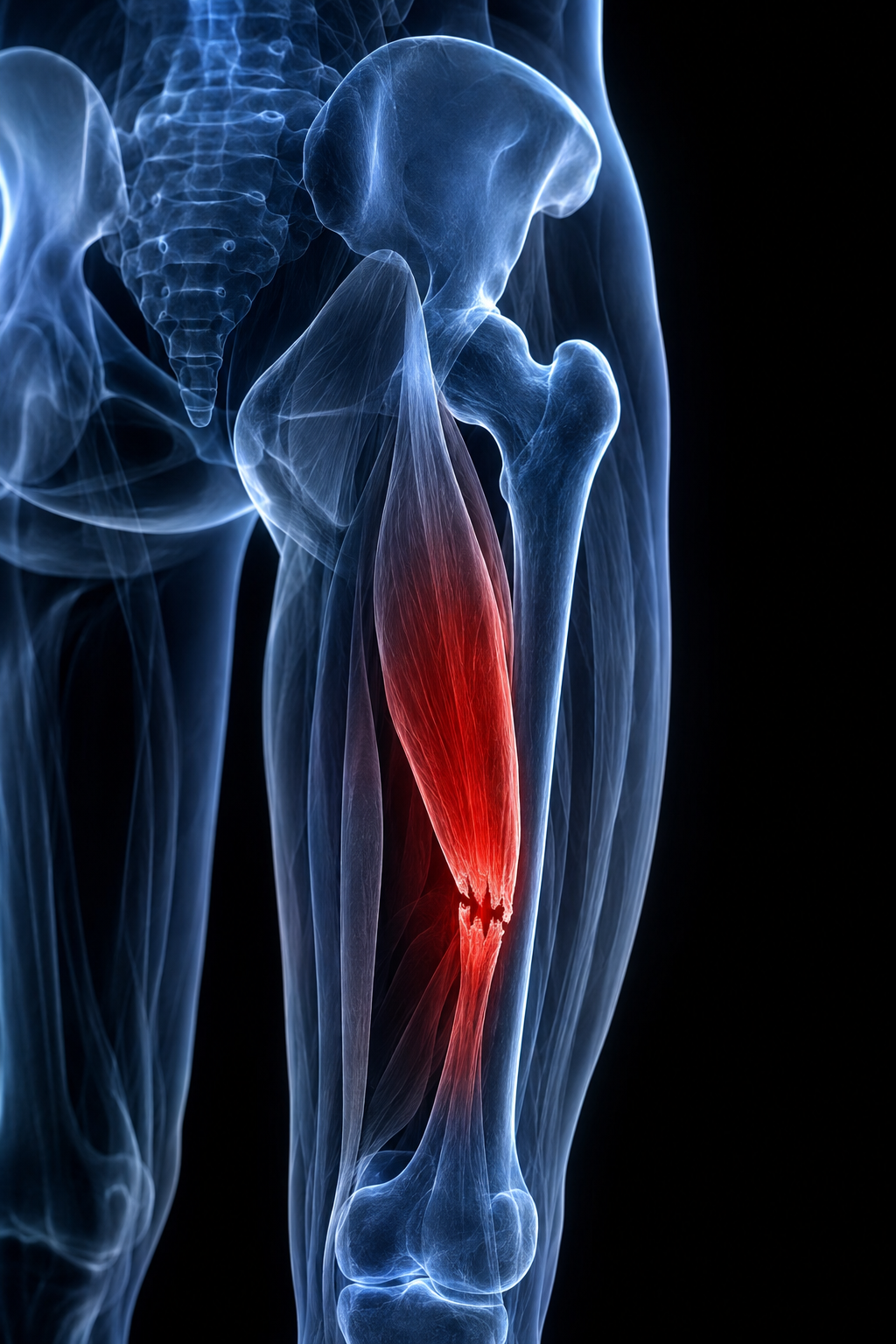
Ask any coach or athlete what causes a hamstring strain and the answer is almost always some version of the same thing: tight hamstrings. The follow-up prescription is equally predictable — stretch more, hold longer, get looser. It's one of the most consistent pieces of advice in sport, repeated across training rooms, dugouts, and sidelines at every level.
The research doesn't support it. Hamstring strain injury is one of the most studied soft tissue injuries in sports science, and the evidence on flexibility as a risk factor is surprisingly weak — and in some analyses, flexibility alone fails to predict injury at all. A 2025 prospective cohort study following 120 soccer players for an entire competitive season found that hamstring isometric strength was not a statistically significant predictor of injury. The strongest predictor was prior hamstring injury — by a wide margin. A 2025 systematic review identified the primary contributors as prior injury history, neuromuscular deficiencies, excessive load, and muscle-tendon architecture — not flexibility.
At KRU Physical Therapy + Performance Lab, we work with athletes managing hamstring strains and trying to prevent the next one. The question this blog is built around is the one athletes most need answered before they decide where to put their training attention: if tightness isn't the primary problem, what is?
01 | What's Actually Happening When the Hamstring Strains
Hamstring strains almost always occur during high-speed running — specifically during the late swing phase of the sprint cycle, when the biceps femoris long head is simultaneously at or near its maximum length and under high eccentric demand to decelerate the swinging leg before foot contact. This is the most mechanically loaded position the hamstring ever reaches, and it's the point where the muscle is most vulnerable.
The Biceps Femoris Long Head: The Most Strained Structure
The hamstring group includes four muscles — the biceps femoris long head, biceps femoris short head, semimembranosus, and semitendinosus — but it's the biceps femoris long head (BFlh) that accounts for the overwhelming majority of hamstring strains in sprinting and high-speed sport. Its anatomical characteristics make it particularly susceptible: it crosses two joints (the hip and the knee), is loaded eccentrically at extreme length during the late swing phase, and has architectural properties — specifically fascicle length and pennation angle — that determine how much force it can absorb before reaching failure.
The Eccentric Loading Mechanism
The injury happens eccentrically — the muscle is actively contracting to resist lengthening while simultaneously being stretched toward its maximum. This is not a passive stretch to the point of tearing. It's a failure of the muscle-tendon unit to absorb the eccentric force load being placed on it during a high-velocity movement. That distinction matters for everything that follows: if the failure mode is eccentric force absorption, then the relevant question is not "how long is the hamstring?" but "how much eccentric force can it handle at high speed and at long muscle length?"
02 | What the Research Says About Flexibility as a Risk Factor
The relationship between hamstring flexibility and injury risk is more complicated than the conventional advice suggests — and the evidence is far less consistent than most athletes and coaches assume.
The Mixed Evidence on Flexibility
Some studies have found a relationship between reduced hamstring flexibility and injury risk. A prospective cohort study in college American football players found that injured players had significantly lower hamstring flexibility than uninjured players. That finding is real and shouldn't be dismissed. But other prospective studies have found no significant relationship between hamstring flexibility and injury incidence, and the 2025 systematic review that synthesized this body of research identified flexibility as a much weaker and less consistent predictor than prior injury history, neuromuscular deficiencies, and tissue architecture. The field's current position is that flexibility may be a contributing factor in some populations, but it doesn't explain most hamstring strains on its own — and stretching programs that prioritize flexibility without addressing the other factors leave the most important predictors unaddressed.
Prior Injury: The Strongest Predictor in the Literature
Across prospective cohort studies, systematic reviews, and the most recent machine learning-assisted prediction models, prior hamstring injury is the most consistent and strongest predictor of future hamstring strain. A 2025 study tracking 120 soccer players for a full competitive season found that previous hamstring injury was the most stable contributor to injury prediction — more than age, BMI, isometric hamstring strength, or hip strength. Research across multiple sports has found that athletes with a prior hamstring strain carry 2 to 6 times the injury risk of those without one, with most recurrences occurring within the first two months of return to sport.
The reason prior injury predicts future injury this strongly is structural. A healed hamstring strain leaves behind scar tissue at the myotendinous junction — tissue with different mechanical properties than the original muscle. The scar is stiffer, less extensible, and generates different force-length characteristics than healthy muscle. If the athlete returns to high-speed running before the tissue has fully remodeled and the surrounding muscle has rebuilt its eccentric capacity, the repaired site represents a relative weakness — and the next high-demand sprint loads it the same way the first one did.
03 | The Risk Factors That Actually Predict Hamstring Strain
A 2025 systematic review in the European Orthopaedic Research identified the primary contributors to hamstring strain injury prevalence as prior injury history, neuromuscular deficiencies, excessive load, and muscle-tendon architecture. Each of these deserves unpacking.
Neuromuscular Deficiencies: Eccentric Strength at Long Muscle Lengths
The most clinically actionable of the neuromuscular deficiencies is eccentric hamstring strength — specifically the ability to produce and absorb force eccentrically at the long muscle lengths that sprinting demands. This is where the Nordic hamstring exercise has generated the most compelling research: programs using the Nordic consistently reduce hamstring strain incidence by around 51% in prospective trials. But the specific mechanism matters for how the exercise is understood and prescribed. The Nordic loads the hamstring eccentrically at shorter muscle lengths — knee dominant, hip in relative extension. Research comparing Nordic training to lengthened-state eccentric training found that training at longer muscle lengths (hip flexed, knee extending) produced 18% greater hamstring hypertrophy overall and 19% greater BFlh hypertrophy specifically. For athletes whose hamstring strains occur primarily during late swing — at long muscle lengths — this architectural adaptation may be more directly protective than Nordic strength alone.
Muscle-Tendon Architecture: Fascicle Length Matters
One of the more mechanistically important findings in hamstring injury research concerns fascicle length — the length of the individual muscle fiber bundles that make up the muscle. A muscle with longer fascicles contains more in-series aligned sarcomeres, which allows it to contract over a greater range of motion, generate force across a wider length spectrum, and absorb eccentric loads more effectively before reaching the point of microscopic failure. Research has found that athletes with shorter BFlh fascicle lengths are at significantly higher injury risk than those with longer fascicles — and that eccentric training, particularly at long muscle lengths, can meaningfully increase fascicle length over a training block. This is a structural adaptation that stretching cannot produce. Passive flexibility training doesn't lengthen fascicles the way progressive eccentric loading does.
Excessive Load and Workload Spikes
The same ACWR principles that apply to Achilles tendon injury and iliopsoas strain apply directly to hamstring strain — the tissue's capacity to absorb high-speed eccentric load is a trainable quality that adapts slowly, and when workload spikes faster than that adaptation can keep pace, the risk of strain rises sharply. Preseason ramp-ups, tournament weekends, return from illness or injury, and rapid increases in high-speed running volume are the contexts where hamstring strains cluster. The pattern is the same as every other overuse and acute soft tissue injury: acute demand exceeds chronic capacity, and the tissue pays the price.
H:Q Ratio Imbalance
The hamstring-to-quadriceps (H:Q) strength ratio is a secondary but consistent finding. A ratio below 0.75 at high angular velocities — meaning the hamstrings can produce less than 75% of the force the quadriceps can — has been associated with elevated hamstring injury risk in multiple prospective studies. The practical implication is that athletes who predominantly train the quadriceps without proportional hamstring loading over time develop an imbalance that places the hamstring in a relatively weaker position when it's asked to decelerate a leg driven forward by the hip flexors and knee extensors. This is particularly relevant for athletes whose training emphasizes sagittal plane quadriceps loading — squats, leg press — without equivalent eccentric hamstring work.
04 | What This Means for Prevention
The research converges on a clear direction: hamstring strain prevention should be built around eccentric strength training, load management, and adequate return-to-sport criteria after prior injury — not primarily around flexibility programs.
| Risk Factor | Evidence Level | Most Effective Intervention |
|---|---|---|
| Prior hamstring injury | Strongest, most consistent across studies | Full eccentric strength restoration before return; criteria-based RTS not time-based |
| Low eccentric hamstring strength | Strong — directly linked to injury mechanism | Nordic hamstring exercise; lengthened-state eccentric training for BFlh hypertrophy |
| Short BFlh fascicle length | Moderate-strong — architectural risk factor | Progressive eccentric loading at long muscle lengths; Romanian deadlifts, good mornings, Nordic |
| Workload spike | Strong — consistent with ACWR literature | Progressive ramp-up; ACWR monitoring; planned return after rest periods |
| Low H:Q ratio | Moderate — consistent secondary finding | Proportional hamstring loading alongside quadriceps work; eccentric emphasis |
| Poor flexibility / reduced passive length | Weak and inconsistent — not a reliable predictor across studies | Not a primary prevention target; may be secondary; does not address eccentric capacity |
The Nordic Hamstring Exercise: What It Does and What It Doesn't
The Nordic hamstring exercise has the strongest evidence base of any single intervention for hamstring strain prevention — 51% injury rate reduction in prospective trials is a large effect by any standard. But understanding why it works matters for how it's used. The Nordic builds eccentric knee flexor strength at relatively short muscle lengths — hip extended, knee moving from flexion toward extension. It increases hamstring muscle volume, eccentric torque capacity, and — importantly — fascicle length over a training block. Where it's limited is at the long muscle lengths of late swing phase sprinting, which is why lengthened-state eccentric training (exercises performed with the hip flexed and the hamstring loaded at longer lengths, like RDLs, good mornings, or lengthened-position hamstring curls) may provide additional protection beyond what the Nordic alone offers. The two approaches are complementary, not interchangeable.
05 | Putting This Into Practice
- If you've had a prior hamstring strain, treat it as your highest injury risk factor — not a resolved problem. The tissue remodels, but eccentric strength at high velocity and long muscle lengths takes deliberate training to restore, not just time.
- Include eccentric hamstring loading consistently — the Nordic hamstring exercise and Romanian deadlifts are the two most evidence-supported options. Both should be progressed systematically, not performed occasionally as accessory work.
- Be cautious at the start of any high-speed running block — preseason, return from a break, or any stretch of increased sprint volume. These are the highest-risk windows for hamstring strain and the moments to monitor load most carefully.
- Stretching is not wasted time, but it shouldn't be your primary hamstring injury prevention strategy. Passive flexibility doesn't build eccentric capacity, doesn't lengthen fascicles, and doesn't address the actual mechanism of strain.
- Implement the Nordic hamstring exercise year-round — not just in preseason. A 51% reduction in injury rate is only realized with consistent, progressive programming, not intermittent use.
- Add lengthened-state eccentric hamstring work alongside the Nordic — Romanian deadlifts, good mornings, and lengthened-position hamstring curl variations specifically address the long muscle length loading that sprinting demands and that the Nordic alone doesn't fully cover.
- Apply return-to-sport criteria after hamstring strain that go beyond pain resolution. Eccentric strength symmetry and pain-free high-speed sprint exposure are the minimum before full clearance. Most reinjuries happen because athletes returned to sprint velocity before these were restored.
- Monitor the H:Q ratio in strength testing — athletes below 0.75 at high velocities have a measurable imbalance that standard training may not correct without deliberately increasing hamstring loading relative to quadriceps work.
Hamstring strain is a multifactorial injury — prior injury, eccentric strength deficits, muscle architecture, load spikes, and strength imbalances all contribute. Flexibility is a small and inconsistent piece of that picture. The athletes who stay healthy are the ones whose training addresses the factors that actually predict the injury — not the ones who stretch the longest before practice.
Dealing With a Hamstring Strain or Trying to Prevent the Next One?
At KRU Physical Therapy + Performance Lab, we assess eccentric hamstring strength, identify return-to-sport readiness, and build progressive programs that address the actual risk factors behind hamstring strain — for athletes at every level, across every sport. Two locations across South Florida, plus telehealth worldwide.
References
- Hagos A, Merchant AA, Kayani B, Yasen AT, Haddad FS. Risk factors and injury prevention strategies for hamstring injuries: a narrative review. EFORT Open Rev. 2025;10(8):636–645.
- Kekelekis A, et al. Hamstring Strain Injury Risk in Soccer: An Exploratory, Hypothesis-Generating Prediction Model. Muscles. 2025;4(4):50. (Prior injury as strongest predictor; isometric hamstring strength not significant.)
- Hamstring injury risk factors in male college American football players — prospective cohort study. BMC Musculoskeletal Disorders. 2023. (Flexibility and H:Q ratio findings.)
- Timmins RG, et al. Short biceps femoris fascicles and eccentric knee flexor weakness increase the risk of hamstring injury in elite football (soccer): a prospective cohort study. Br J Sports Med. 2016;50(24):1524–1535. (Fascicle length as architectural risk factor.)
- van Dyk N, et al. Including the Nordic hamstring exercise in injury prevention programmes halves the rate of hamstring injuries: a systematic review and meta-analysis of 8459 athletes. Br J Sports Med. 2019;53(21):1362–1370. (51% injury reduction.)
- Presland JD, et al. Hamstrings Hypertrophy Is Specific to the Training Exercise: Nordic Hamstring versus Lengthened State Eccentric Training. Med Sci Sports Exerc. 2024. (18–19% greater BFlh hypertrophy with LSET vs Nordic.)
- Effects of 8 weeks of dynamic hamstring stretching or Nordic hamstring exercises on performance outcomes in soccer players. BMC Sports Science. 2025. (NHE superior to stretching across multiple outcomes.)
- Nishida S, et al. Relationship between Nordic hamstring strength and maximal voluntary eccentric, concentric and isometric knee flexion torque. PLoS One. 2022;17(2):e0264465.
- Opar DA, Williams MD, Shield AJ. Hamstring strain injuries: factors that lead to injury and re-injury. Sports Med. 2012;42(3):209–226.
- Croisier JL, et al. Factors associated with recurrent hamstring injuries. Sports Med. 2002;32(14):905–916. (H:Q ratio and recurrence.)