
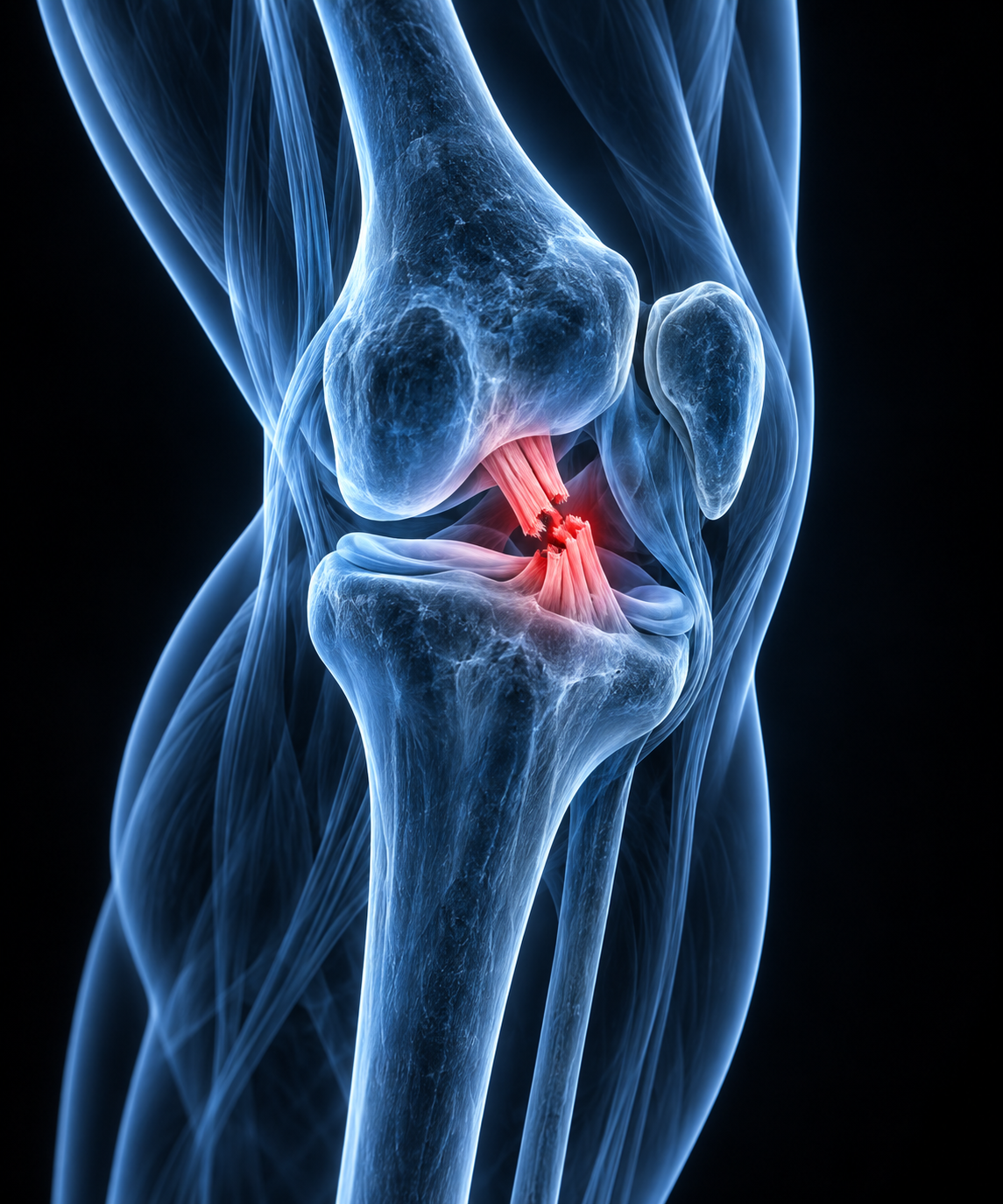
When an athlete goes down clutching their knee on a play with no contact involved, the reaction in the stands is almost always confusion. Nothing happened. Nobody touched them. Yet the ACL is torn.
This is not a rare occurrence. A systematic review and meta-analysis across 45 studies covering 13 team ball sports found that 55% of all ACL injuries — more than half — occur without contact to the injured knee. In soccer specifically, that number climbs to 84%. In professional athletes across sports, video analysis studies have consistently found non-contact mechanisms predominating across the literature. The injury that most people assume requires a collision is, statistically, more likely to happen when no one touches the athlete at all.
That finding doesn't just change how we understand ACL injury — it changes who is responsible for preventing it. If most ACL tears happen without contact, they aren't accidents that can be avoided by better protective equipment or rule changes alone. They're the product of biomechanical and neuromuscular failures that occur during movements the athlete themselves performs — and that means they're at least partially trainable.
At KRU Physical Therapy + Performance Lab, we work with athletes across football, basketball, soccer, volleyball, and every other multidirectional sport in between. The non-contact ACL tear is the injury we talk about most — because it's the one the research most consistently tells us can be reduced.
01 | How a Non-Contact ACL Tear Actually Happens
Understanding the non-contact ACL injury mechanism is the starting point for understanding what can be done about it. These injuries don't happen randomly — they follow a consistent biomechanical pattern that video analysis research has now described in detail across multiple sports and competition levels.
The Injury Movement Pattern
The majority of non-contact ACL tears occur during one of three movements: a single-leg landing after a jump, a rapid deceleration from high-speed running, or a cutting maneuver with plant-and-pivot. In each case, the common thread is the same: the foot is planted on the ground while the body is still moving, the knee is near or approaching extension, and the combined forces of ground reaction, quadriceps activation, and multiplanar motion place the ACL under tensile load it cannot withstand.
A 2025 scoping review of ACL injury mechanisms across multiple sports found that non-contact injuries most commonly occur at medium to high horizontal speeds — during the transition between deceleration and change of direction, not during low-speed controlled movements. The ACL fails not because the athlete was moving carelessly, but because the neuromuscular system didn't generate the right muscle activation pattern at the right moment to protect the joint from the forces it was experiencing.
The Knee Valgus Mechanism
The most consistently identified biomechanical pattern in non-contact ACL injury is dynamic knee valgus — the inward collapse of the knee during landing or cutting. Research has shown that individuals with ACL injuries demonstrate significantly greater knee valgus angles and greater external knee abduction moments compared to uninjured athletes during similar movements. This valgus loading pattern combines frontal plane collapse with tibial external rotation and internal rotation of the femur — a multiplanar loading event that places maximum stress on the ACL.
Landing Mechanics: The Critical Window
Research on young athletes published in 2026 found that landing-related injuries accounted for 81.5% of all ACL injuries, including both contact and non-contact mechanisms — suggesting that how an athlete absorbs ground contact forces is the central movement quality the ACL depends on across nearly all injury contexts. Athletes who land with a more erect knee (less flexion), greater forward trunk lean, and higher knee abduction moments are consistently at higher risk. Each of these is a measurable, trainable variable — not a fixed anatomical fate.
02 | Who Is Most at Risk — and Why
Non-contact ACL injury risk is not distributed equally across sports, sexes, or athlete populations. The research identifies several consistent patterns that have direct implications for where prevention efforts should be concentrated.
Female Athletes: A Consistent and Significant Disparity
Across sex-comparable sports — basketball, soccer, volleyball — female athletes sustain ACL tears at significantly higher rates than male athletes. In NCAA surveillance data, women's soccer carries the highest ACL injury rate of any sport at 2.60 per 10,000 athlete-exposures, and non-contact mechanisms are more prevalent in women's sports than men's across the NCAA injury database. A systematic review found that the incidence of non-contact ACL injuries in female athletes was 0.14 per 1,000 player-hours — nearly three times the male rate of 0.05 per 1,000 player-hours.
The biomechanical contributors to this disparity are well-documented: female athletes on average demonstrate greater knee valgus angles during landing, lower hip abductor and external rotator strength, different neuromuscular activation timing, and a wider pelvis-to-femur ratio that creates a structural predisposition toward dynamic valgus. Hormonal factors — specifically the effects of estrogen and progesterone on ligament laxity and neuromuscular control — are also an active research area, though the magnitude of their contribution relative to biomechanical and strength factors remains a subject of ongoing study.
The Sport-Specific Pattern
Non-contact ACL injury rates vary meaningfully by sport, and so does the specific movement context in which injuries cluster.
| Sport | Non-Contact ACL Rate | Most Common Injury Situation |
|---|---|---|
| Women's Soccer | 2.60 per 10,000 AE (NCAA) — highest of any sport | Defensive situations, within the first 15 minutes of play |
| Men's Football | 1.44 per 10,000 AE (NCAA) — highest of men's sports | More contact-driven than other sports; non-contact still significant at skill positions |
| Women's Basketball | Higher than men's basketball across comparable levels | Jump landing, deceleration after drive |
| Soccer (professional, all) | 84% of ACL tears non-contact | Cutting and deceleration; 44.5% involve defenders |
| Professional Basketball | Video analysis: majority non-contact | Crossover step, single-leg landing after jump |
Timing: When In a Match Injuries Cluster
A 2025 analysis of ACL ruptures in the top 5 European soccer leagues found that most occurred within the first 15 minutes of play — early in the match, before neuromuscular fatigue has accumulated, suggesting that the primary driver is not fatigue-related but situational and biomechanical. This mirrors the Achilles rupture data showing most tears occur early in activity. The athlete's tissue and neuromuscular system are activated but haven't yet had the session time to calibrate. It's a pattern that challenges the assumption that injury risk peaks when athletes are most tired.
03 | The Modifiable Risk Factors: What Training Can Actually Change
The research on non-contact ACL injury risk factors separates clearly into two categories: those that are fixed (anatomy, sex, prior injury history) and those that are modifiable through training. The modifiable factors are the ones that prevention programs have built their evidence base around — and where the clearest opportunity for risk reduction lives.
Hip and Glute Strength
Insufficient hip abductor and external rotator strength is the most consistently identified modifiable contributor to dynamic knee valgus during cutting and landing. The gluteus medius, gluteus maximus, and hip external rotators collectively control femoral rotation and abduction during single-leg loading. When they're weak, the femur internally rotates and adducts under load — the kinematics that drive knee collapse. Systematic reviews of ACL prevention programs have found that those including hip strengthening produce greater reductions in knee valgus angles than programs focused only on the knee and ankle.
Neuromuscular Control and Landing Mechanics
Landing mechanics are not purely a product of anatomy or strength — they're motor patterns that can be learned and modified with targeted training and feedback. Research on neuromuscular training interventions in young female athletes found significant increases in peak knee flexion angle and reductions in knee valgus motion following structured programs. A 2025 network meta-analysis evaluating interventions for reducing ACL injury risk factors found that neuromuscular training and feedback training were among the most effective approaches for improving landing mechanics — more so than strength training alone.
Deceleration Capacity
Deceleration is consistently identified in the mechanism research as the highest-risk movement context for non-contact ACL injury — yet it's one of the least directly trained qualities in most programs. Most athletes practice acceleration far more than deceleration. The ability to absorb ground reaction forces rapidly and symmetrically during high-speed deceleration — maintaining hip and knee flexion, avoiding knee valgus, keeping the trunk from forward-collapsing — is a specific neuromuscular skill that requires deliberate practice under progressively higher load and velocity conditions to develop.
Core Stability and Pelvic Control
A weak or poorly coordinated core fails to stabilize the pelvis during dynamic movements, allowing it to drop on the non-stance side — a movement pattern that cascades destabilization directly down the kinetic chain to the knee. Research has found that athletes with greater core instability demonstrate higher knee abduction moments during cutting, and that core stability training included in multicomponent prevention programs contributes meaningfully to improved lower extremity mechanics under load.
04 | What Prevention Programs Show — and Where the Gap Remains
Neuromuscular training programs designed to address the modifiable risk factors for non-contact ACL injury have a meaningful evidence base. The most studied of these — including the FIFA 11+ warm-up protocol, the PEP program, and various school-based neuromuscular training protocols — have demonstrated ACL injury rate reductions in multiple randomized controlled trials. Programs incorporating plyometrics, strength training, and neuromuscular feedback have shown efficacy across populations.
05 | Putting This Into Practice
- Treat hip and glute strength as knee injury prevention, not just performance training. The knee valgus collapse that loads the ACL during landing originates from the hip — strengthening hip abductors and external rotators directly addresses the primary modifiable biomechanical risk factor.
- Practice landing mechanics deliberately. How you land after a jump — knee flexion angle, trunk position, knee tracking over the foot — is a motor skill, not just anatomy. It responds to cued practice and feedback, and the improvement carries over to game speed with enough repetition.
- Train deceleration explicitly. Most programs prioritize speed and acceleration. Deceleration — absorbing momentum rapidly and changing direction under load — is the context in which most non-contact ACL tears happen and the quality most consistently undertrained.
- If you're a female athlete in a cutting sport, recognize that your baseline non-contact ACL risk is significantly higher than your male counterparts' — not because of something you're doing wrong, but because of documented biomechanical and neuromuscular factors that targeted training can meaningfully address.
- Implement a structured neuromuscular warm-up program. The FIFA 11+, PEP program, and similar protocols have demonstrated ACL injury rate reductions in multiple trials — and they require no equipment and less than 20 minutes per session.
- Include hip strength and landing mechanics training in your off-season and in-season programming, not just agility and conditioning. The modifiable risk factors for non-contact ACL injury are strength and movement quality problems — and they respond to strength and movement quality training.
- Pay particular attention to female athletes in soccer, basketball, and volleyball — the sports with the highest non-contact ACL rates — and to athletes returning from any prior knee injury, who carry elevated risk regardless of how well they passed their return-to-sport screen.
- Understand that non-contact ACL injuries are not random bad luck. They follow a consistent biomechanical pattern that training can modify. The gap between what prevention programs can achieve and the current injury rate reflects how often those programs aren't implemented — not a ceiling on what's possible.
Most ACL tears happen without contact. That means most ACL tears happen because of something going on inside the athlete's own biomechanics — how they land, how they decelerate, how their hip and core control their knee position under load. Those are trainable qualities. They're not easy to train, and no program eliminates the risk entirely — but the evidence is consistent enough, and the injury severe enough, that treating ACL prevention as a genuine training priority rather than an afterthought is one of the most impactful decisions a coach, parent, or athlete can make in the offseason.
Looking to Reduce ACL Injury Risk or Recover From One?
At KRU Physical Therapy + Performance Lab, we assess landing mechanics, hip strength deficits, and neuromuscular control to identify and address the modifiable risk factors behind non-contact ACL injury — and guide athletes through evidence-based return-to-sport rehabilitation after reconstruction. Two locations across South Florida, plus telehealth worldwide.
References
- Chia L, et al. Non-contact Anterior Cruciate Ligament Injury Epidemiology in Team-Ball Sports: A Systematic Review with Meta-analysis by Sex, Age, Sport, Participation Level, and Exposure Type. Sports Med. 2022. (55% non-contact overall; 0.14 vs. 0.05 per 1,000 player-hours by sex.)
- Dewig DR, et al. Epidemiology of Anterior Cruciate Ligament Tears in National Collegiate Athletic Association Athletes: 2014/2015–2018/2019. Med Sci Sports Exerc. 2024;56(1):29–36. (2.60 per 10,000 AE women's soccer; non-contact more prevalent in women's sports.)
- Högberg J, et al. Anterior cruciate ligament injury mechanism in athletes across various sports: a scoping review. Ann Jt. 2025;10:35. (Non-contact most common; medium-to-high horizontal speed; deceleration and neuromuscular control implications.)
- Non-contact and contact ACL injuries in soccer: meniscal tear and bone bruise patterns. ScienceDirect. 2024. (84% non-contact in soccer cohort of 246 athletes.)
- Epidemiology of ACL Ruptures in Top 5 European Football Leagues 2018–2024. PMC. 2025. (Most injuries in first 15 minutes; 44.5% defenders.)
- Sakoda S. Landing-Related Mechanisms Predominate in Anterior Cruciate Ligament Injuries Among Young Athletes Regardless of Contact. medRxiv. 2026. (81.5% landing-related across contact and non-contact.)
- Effective Prevention and Rehabilitation Strategies to Mitigate Non-Contact ACL Injuries: A Narrative Review. Applied Sciences. 2024. (Neuromuscular training; key modifiable risk factors.)
- Preventive interventions on ACL injury reduction based on the Landing Error Scoring System: a systematic review and network meta-analysis. BMC Musculoskeletal Disorders. 2025. (Neuromuscular training ranked second most effective intervention.)
- Influence of Neuromuscular Training on Jump-Landing Biomechanics and ACL Injury Risk in Youth Females: A Systematic Review and Meta-analysis. PMC. 2025. (Increased knee flexion, reduced valgus with NMT.)
- Biomechanical Risk Factors for Increased ACL Loading and Injury: A Systematic Review. PMC. 2025. (Hip and core contribution to valgus; FIFA 11+ evidence.)
- Preliminary brain-behavioral neural correlates of ACL injury risk: bilateral leg press neuroimaging paradigm. PMC. 2022. (~100 NNT; 50% variance unexplained; neurocognitive gap in prevention.)