
Most NFL Achilles Tears Happen Before the Season Even Starts. Here's the Data — and the Biomechanics
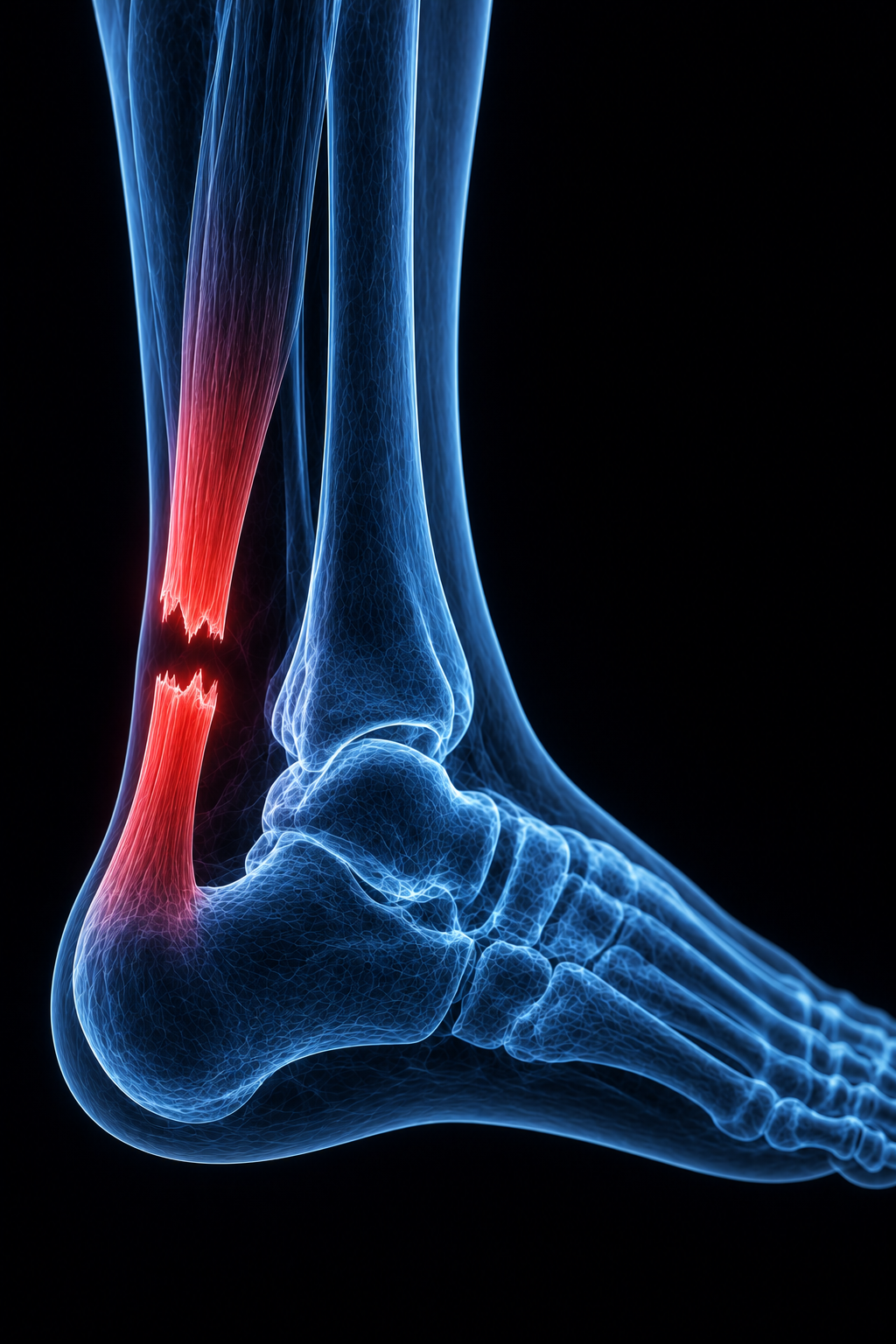
The Achilles tendon rupture has become one of the defining injuries of the modern NFL — the kind that ends seasons, alters careers, and occasionally ends them entirely. What most people don't know is that the majority of these ruptures don't happen in week 12 of a playoff push or on a fourth-quarter drive. They happen before the season starts.
A retrospective analysis of NFL Achilles tendon ruptures from 2010 to 2015 found that 58% occurred during the preseason. A separate study examining 101 documented tears between 2009 and 2016 found that 64% occurred before the official season began — including preseason games and the weeks leading into them. When you add the first month of the regular season, which carries an additional 18% of injuries as the body continues to absorb a transition it wasn't fully prepared for, the picture becomes clear: the highest-risk window for Achilles rupture in the NFL isn't the season itself. It's the ramp-up to it.
At KRU Physical Therapy + Performance Lab, we work with athletes navigating Achilles tendinopathy, post-rupture rehabilitation, and preseason load management. The concentration of injuries in the preseason isn't random — it's biomechanical and physiological, and it follows a pattern that the research has been describing for over a decade.
01 | The Natural Experiment That Made This Undeniable
The clearest evidence that preseason load management is the driver of Achilles rupture concentration comes not from a controlled trial, but from an accident of labor relations. In 2011, a collective bargaining dispute resulted in an NFL lockout that eliminated the structured 14-week offseason conditioning program that normally runs from May through July — the period in which teams progressively build players' physical preparation for the demands of training camp.
When the lockout ended, training camp began just two days later. Players went from months of reduced, unstructured offseason activity directly into full-contact preseason practices and games with no progressive ramp-up period. The result was unprecedented: 12 Achilles tendon ruptures occurred in the preseason alone — a number that researchers at the Journal of Orthopaedic and Sports Physical Therapy flagged as an alarming outlier and directly attributed to the abrupt elimination of the progressive conditioning window that normally absorbs the load transition between offseason and camp.
What the lockout demonstrated in real time was something biomechanists had long theorized: the Achilles tendon doesn't rupture because it's fragile. It ruptures because the load being placed on it has exceeded what it was prepared to handle — and the preseason is exactly the moment when that mismatch is most likely to occur.
02 | Why the Preseason Is the Danger Window
Understanding why Achilles ruptures cluster in the preseason requires understanding the relationship between tendon structure, training load, and the physiology of tissue adaptation — and why each of those factors converges in August in ways they don't at any other point in the season.
The Tendon's Adaptation Timeline
Unlike muscle, which adapts relatively quickly to new training stimuli, tendon tissue adapts slowly — on a timeline measured in weeks to months. Collagen turnover in the Achilles tendon is a gradual process, and the structural reinforcement needed to handle higher loads builds incrementally with consistent progressive exposure. When an athlete spends the offseason at reduced training intensity — as most NFL players do — the tendon's load tolerance gradually decreases to match the demand placed on it. It doesn't retain full in-season capacity through the summer.
When preseason camp begins and full-speed sprinting, cutting, and blocking resume immediately, the tendon is being asked to handle forces it hasn't been progressively prepared for. The muscle-tendon complex can generate significantly more force than the tendon can structurally absorb — the mismatch between muscle capacity and tendon tolerance is where the rupture risk lives.
The Acute:Chronic Workload Spike
The same Acute:Chronic Workload Ratio (ACWR) framework that applies to UCL injuries in pitchers and iliopsoas strains in soccer players applies directly here. The offseason represents a chronically low baseline of tendon loading. Camp represents an abrupt and dramatic acute load spike — full-speed practice twice daily, contact drills, scrimmages — imposed on a tendon whose chronic baseline has been declining for weeks or months. When the acute load dramatically exceeds the chronic foundation, the risk of non-contact soft tissue injury rises sharply. The Achilles tendon, with its slow adaptation timeline, is one of the structures most vulnerable to that mismatch.
03 | The Biomechanics of How It Happens
The Achilles tendon rupture in professional athletes is almost never what it looks like on the field. Viewers see a player suddenly drop without contact and assume a collision or awkward landing caused it. Video analysis research tells a different story.
Non-Contact Mechanisms Predominate
Across multiple video analysis studies of professional football, soccer, and basketball players, non-contact mechanisms account for 64% to 100% of Achilles tendon ruptures. In professional soccer, 83% of ruptures were non-contact. In the NBA, 81.5% occurred without direct contact. The injury typically happens during one of three movement patterns: forward acceleration from a stationary or near-stationary position, crossover cutting, or push-off during vertical jumping.
The False Step and the Acceleration Mechanism
The most consistent biomechanical pattern identified in video analysis is what researchers call the "false step" — a movement sequence in which the athlete plants one foot while the body rapidly accelerates in the opposite direction, loading the calf-Achilles complex with a sudden, high-magnitude eccentric demand. Biomechanical analysis of rupture events in professional soccer found a consistent injury-frame posture: slightly flexed trunk, extended hip, early-flexed knee, and end-range dorsiflexed ankle — a position that places maximum tensile load on the Achilles at the moment peak force is generated. The tendon fails not because of a traumatic collision but because the demand of the movement exceeded what the tissue could structurally absorb at that moment.
Critically, 45% of Achilles ruptures in professional soccer occurred in the first 30 minutes of match play — early in the activity period, when the tendon has been activated but the neuromuscular fatigue that might slow movement hasn't yet accumulated. This is consistent with a tissue that's operating near its load limit from the outset, rather than one that degrades to failure over the course of a session.
The Role of Prior Tendinopathy
Most Achilles tendon ruptures in athletes occur in tendons that have some degree of pre-existing degenerative change — tendinopathy that was either asymptomatic, under-managed, or both. Research consistently identifies internal tendon structural changes as a precursor to rupture risk. An athlete who has had Achilles symptoms in the preceding months — stiffness, morning pain, localized thickening — and who either doesn't address them or returns to full training before the tendon has rebuilt its load tolerance, arrives at camp with a tissue that is already closer to its failure threshold than a healthy one.
04 | What a Rupture Actually Costs
The consequences of an Achilles tendon rupture in the NFL extend well beyond the immediate season. The research on long-term performance outcomes is sobering and applies to athletes at every level — not just professionals.
| Outcome | Finding |
|---|---|
| Average recovery timeline | 9 months from date of injury to return to play |
| Players who never return to the NFL | 26% do not return to play at the professional level |
| Performance reduction (power rating) | Net decrease of 22% across all positions over 3 years following return |
| Performance reduction — wide receivers | 88% reduction in power rating over 3-year post-injury period |
| Performance reduction — running backs | 83% reduction over 3 years |
| Performance reduction — linebackers | 95% reduction over 3 years |
The 9-month return timeline means a preseason Achilles rupture doesn't just cost the current year — it frequently costs the following preseason too. And the performance data suggests that even athletes who return to the field do so at a meaningfully diminished level, with the most explosive skill positions showing the greatest sustained decrement.
05 | What the Preseason Risk Window Means for Load Management
The concentration of Achilles tears in the preseason isn't a problem that helmets, rule changes, or surgical advances can solve. It's a load management problem — one that responds to the same principles of progressive tissue loading that apply to every other overuse and acute tendon injury in sport.
The Offseason Conditioning Window Is Not Optional
What the 2011 lockout demonstrated is that the 14-week structured offseason conditioning program the NFL uses isn't padding in the calendar — it's the biological preparation period the tendon needs to rebuild the chronic load baseline that camp demands. For athletes at every level, the equivalent principle holds: an abrupt transition from low-activity offseason to high-intensity camp is a workload spike the Achilles is poorly positioned to absorb, regardless of how strong or conditioned the athlete feels subjectively.
Include eccentric and heavy slow-resistance calf loading specifically. These modalities have the strongest evidence for improving tendon structural quality and load tolerance, not just muscle strength.
Monitor the ACWR across the first two weeks of camp. The highest-risk period for non-contact tendon injury is when acute load spikes fastest above the chronic baseline — the opening week of two-a-days is the most dangerous stretch of the season for Achilles tissue.
Take prior tendon symptoms seriously. An Achilles that has been stiff, sore, or thickened in the offseason is not a healthy tendon that needs more conditioning — it's a tissue already closer to its load limit that needs graduated exposure, not a sudden spike.
06 | A Problem That's Getting Worse — and the Surface Data Behind It
The preseason concentration of Achilles tears isn't the only troubling trend in the data. Researchers have also flagged that Achilles tendon injury rates in the NFL have been climbing over time — not staying flat as equipment improves and medical care advances.
Rising Injury Rates Year Over Year
A 2024 clinical insight published in the International Journal of Sports Physical Therapy examined whether Achilles tendon injuries had reached "unacceptably high incidence levels" in the NFL and attempted to explain why. The answer was yes — rates have trended upward across multiple seasons, with year-over-year increases that have prompted researchers and clinicians to ask whether changes in practice scheduling, surface composition, or training methodology are driving the trend. The 2023 season alone saw several high-profile ruptures that reignited the public conversation, including Aaron Rodgers' injury four snaps into his debut with the New York Jets — a single play that crystallized the precariousness of an athlete returning to full competitive intensity after a period of relative deconditioning.
The 15-year retrospective published in 2025 — covering every documented NFL Achilles tendon strain, tear, and rupture from 2009 through 2024 — confirmed that the injury burden has remained substantial across the full study period, with implications for both player safety and roster management that teams have not yet fully solved through medical or operational means alone.
The Surface Question: Artificial Turf vs. Natural Grass
One of the most actively debated variables in the rising injury conversation is playing surface. The NFL Players Association has formally advocated for natural grass transitions across league stadiums based on injury surveillance data — and the research gives them legitimate ground to stand on.
An analysis of season-ending lower extremity injuries across the 2020, 2021, and 2022 NFL seasons found that artificial turf accounted for 60.3% of season-ending injuries despite teams playing only 55.6% of their games on it — a disproportionate burden that points to surface as a contributing variable. A separate study of the 2021–2022 seasons specifically found higher rates of lower extremity injury on synthetic turf compared to natural grass: 1.42 injuries per game on artificial surfaces versus 1.22 on grass. The NFL's own injury surveillance data from those seasons found significantly increased odds of season-ending injury on artificial turf, and the NFLPA's position — advocating for natural grass across all stadiums — is directly grounded in that data.
07 | Putting This Into Practice
- Don't treat the Achilles as an afterthought during offseason training. If your calf-Achilles complex hasn't been progressively loaded in the 8–12 weeks before camp, it is not prepared for what camp demands — regardless of how your legs feel.
- Pay attention to morning stiffness, localized tendon thickening, and pain that improves with warm-up but returns after activity. These are classic early tendinopathy signs — and a tendinopathic tendon going into camp carries meaningfully higher rupture risk than a healthy one.
- If you're a rookie entering professional or high-level collegiate camp for the first time, recognize that you represent a specific high-risk population in the data. The demands of your new environment are higher than what your tendon has been chronically prepared for.
- Monitor Achilles tendon symptoms and calf strength closely during the first two weeks of camp — the period when the ACWR spike is steepest and rupture risk is highest across the data.
- Design preseason ramp-up protocols that treat tendon adaptation as the limiting factor, not cardiovascular fitness or muscle strength. The Achilles adapts slower than everything else in the body and needs more lead time than the calendar typically allows.
- Flag veterans over 32 and rookies entering their first professional camp as your two highest-priority populations for Achilles monitoring — the bimodal age distribution in the research identifies both groups as carrying disproportionate risk for different physiological reasons.
- Ensure the offseason conditioning program includes progressive tendon loading — not just cardiovascular conditioning and positional skill work. The 2011 lockout showed what happens when that window is eliminated.
The preseason concentration of Achilles ruptures in the NFL is one of the clearest examples in all of sports medicine of a predictable injury pattern that the data has been describing for over a decade. The tendon doesn't fail randomly. It fails when load exceeds tissue tolerance — and the preseason is structurally designed to create exactly that condition if the preceding weeks haven't been used to build the tolerance the camp demands.
Managing Achilles Pain or Preparing for a High-Intensity Camp?
At KRU Physical Therapy + Performance Lab, we help athletes assess Achilles tendon health, build progressive load tolerance before camp, and navigate post-rupture rehabilitation — for athletes at every level. Two locations across South Florida, plus telehealth worldwide.
References
- Ready LV, Li NY, Worobey S, et al. Influence of Preseason Versus In-Season Play on Achilles Tendon Injuries in the National Football League. Orthop J Sports Med. 2021. (64% preseason finding, bimodal age distribution.)
- Epidemiology and Outcomes of Achilles Tendon Ruptures in the National Football League. Orthop J Sports Med Supplement. 2017. (58% preseason; 26% never return; 9-month average recovery.)
- Hewett TE, Lavender CD, Schaver AL. An Apparent Achilles Heel of the NFL: Have Achilles Tendon Injuries Significantly Increased to Unacceptably High Incidence Levels in the NFL and if so, why? IJSPT. 2024. (2011 lockout analysis.)
- Did the NFL Lockout Expose the Achilles Heel of Competitive Sports? Journal of Orthopaedic & Sports Physical Therapy. 2011. (12 preseason ruptures post-lockout.)
- Video analysis of Achilles tendon rupture in male professional football (soccer) players: injury mechanisms, patterns and biomechanics. PubMed. 2022. (83% non-contact; 45% in first 30 min; false step mechanism.)
- Achilles tendon ruptures in National Basketball Association players: A sequential video analysis of injury mechanisms and biomechanical patterns. PubMed. 2025. (81.5% non-contact NBA data.)
- Acceleration and Injury-Frame Biomechanics in Achilles Tendon Rupture: A Systematic Review. MDPI. 2026. (64–100% non-contact across sports.)
- Queenan K, et al. Extrinsic Factors Contributing to Achilles Tendon Ruptures During NFL Games 2010–2023. Orthop J Sports Med. 2026.
- Epidemiology and outcomes of Achilles tendon ruptures in the National Football League (1997–2002). PubMed. 2010. (88%, 83%, 95% power rating reductions by position.)
- Gridiron Gastrocs: A 15-Year Review of NFL Achilles Tendon Injuries (2009–2024). Orthop J Sports Med Supplement. 2025.
- Field Surface Type and Season-Ending Lower Extremity Injury in NFL Players. PMC. 2024. (Artificial turf: 60.3% of season-ending injuries on 55.6% of games.)
- Venishetty N, et al. Lower Extremity Injury Rates on Artificial Turf Versus Natural Grass Surfaces in the National Football League During the 2021 and 2022 Seasons. Orthop J Sports Med. 2024. (1.42 vs. 1.22 injuries per game.)
- College-to-NFL Stadium Turf Transitions as a Risk Factor for Lower Extremity Non-Contact Injuries in Rookie Players: A 13-Year Cohort Analysis. PMC. 2025.