
What's Causing Turf Toe to Show Up So Often During NFL Training Camp
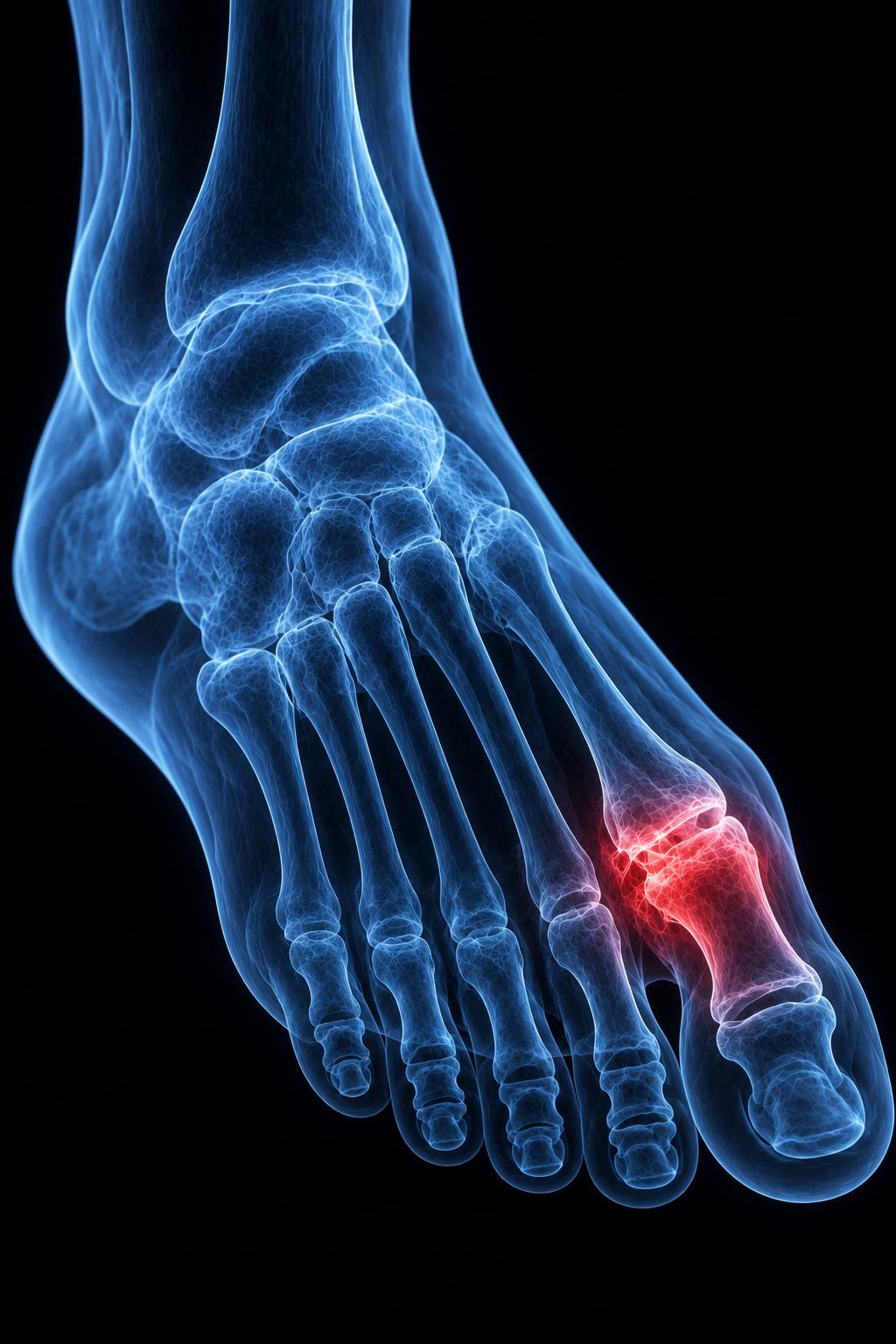
Every camp season, turf toe cases start showing up in clinical settings with a predictability that makes the timing almost unsurprising. Athletes who spent the offseason away from full-speed cutting, sprinting, and contact return to camp on artificial turf in lightweight flexible cleats, and the first metatarsophalangeal joint — unprepared for that combination — pays the price.
It's estimated that up to 45% of professional NFL players will experience at least one MTP sprain over the course of their career. At the collegiate level, turf toe injuries on third-generation artificial surfaces occur at nearly twice the rate as on natural grass. And while the injury itself is often dismissed as a minor toe problem, a Grade 2 or 3 turf toe managed poorly can linger for an entire season — altering push-off mechanics, limiting sprint speed, and setting the stage for a chronic problem that compounds with every week the athlete returns to the field before the joint has fully recovered.
At KRU Physical Therapy + Performance Lab, we see turf toe presentations cluster heavily in August and early September — the heart of camp season. Understanding why it shows up at this specific time, and what's actually driving it, is the starting point for managing it more intelligently.
01 | What Turf Toe Actually Is
Turf toe is a sprain of the first metatarsophalangeal (MTP) joint — the large joint at the base of the big toe — caused by forced hyperextension beyond its functional range. The injury targets the plantar capsuloligamentous complex: the plantar plate, the joint capsule, the sesamoid ligaments, and the flexor hallucis brevis tendon attachment. These structures collectively prevent the toe from bending too far backward, and when they're loaded past their tolerance, they stretch, partially tear, or fully rupture depending on the severity of the force involved.
The Mechanism
The classic turf toe mechanism involves the forefoot planted on the ground with the great toe in contact with the surface while a force drives the body forward — hyperextending the first MTP joint beyond its normal range. This happens most commonly during push-off in sprinting, cutting, and blocking: the heel rises, the weight loads onto the forefoot and toe, and if the surface grips the shoe enough to prevent normal foot progression while the body continues moving forward, the toe takes the full load of that force. Research identifies a 50% risk of injury at approximately 78 degrees of hallux dorsiflexion — a threshold that gets reached more easily on high-grip surfaces with flexible footwear than on natural grass with a stiffer sole.
Why It's Not Just an Artificial Turf Problem Anymore
Turf toe was first described in the late 1970s, when early-generation astroturf — a hard, unforgiving surface with high shoe-surface friction — combined with flexible soccer-style cleats created the conditions for epidemic MTP hyperextension injuries. Modern high-pile artificial surfaces behave significantly more like natural grass, and injury rates on third-generation turf are lower than on original astroturf. But the injury pattern hasn't gone away — it's shifted. The bigger driver now is footwear. The trend toward lightweight, minimal, highly flexible cleats across football, soccer, basketball, and court sports has removed much of the passive bony and structural restraint that older, stiffer athletic footwear provided. An athlete's shoe now allows MTP dorsiflexion that a traditional cleat would have limited before it became a clinical problem.
02 | Why Camp Is When It Clusters
The timing of turf toe presentations isn't coincidental. Camp creates a specific convergence of conditions that the first MTP joint is particularly vulnerable to — all arriving at the same time, after months of relative reduction in high-speed sprint and cutting volume.
Load Spike After Offseason Detraining
The most consistent underlying factor is the workload spike. Athletes who have spent the offseason training at reduced sport-specific intensity return to camp and immediately begin practicing at full volume — two-a-days, padded contact, full-speed drills — on a joint that has partially detrained its load tolerance over the preceding months. The plantar plate and joint capsule, like other soft tissue structures, adapt to loading over time. An abrupt return to the forces of full-speed football after weeks or months of lower-intensity activity puts structures in a state of relative unpreparedness for the demand being placed on them.
Surface and Footwear Combination
Many camp facilities — particularly at the high school and collegiate level — train heavily on artificial turf. The higher shoe-surface friction of artificial turf compared to natural grass increases the force required to move the foot forward from a planted position, which directly increases the dorsiflexion demand on the first MTP joint during push-off. Combined with lightweight, flexible practice cleats — the preferred footwear of most skill position players — the structural restraint on MTP hyperextension is minimal. The surface holds the shoe; the shoe offers no resistance to the toe bending back; the joint absorbs the full load.
Contact Volume
NCAA data found that athletes were nearly 14 times more likely to sustain a turf toe injury during games than during practice. Camp includes the highest density of controlled scrimmage and contact work in the entire training calendar — which means a concentration of game-like forces applied to the first MTP joint across a compressed period of time. The combination of high contact volume, full-speed push-off demands, and a joint that hasn't yet rebuilt camp-level load tolerance creates the exact conditions the injury needs.
03 | Grading Turf Toe and What Each Grade Means for Return to Sport
Turf toe severity varies considerably, and the clinical decision making around return to sport depends heavily on grade. Managing a Grade 1 like a Grade 3 costs an athlete unnecessarily missed time; managing a Grade 3 like a Grade 1 is one of the most reliable paths to a chronic first MTP problem that limits performance for years.
| Grade | What Happened | Presentation | Return Timeline |
|---|---|---|---|
| Grade 1 | Microscopic stretching of the plantar capsule without disruption; ligaments intact | Mild localized tenderness and swelling at the MTP joint; pain with end-range dorsiflexion but no significant functional limitation | 3–5 days with taping, activity modification, stiff-soled footwear |
| Grade 2 | Partial tear of the plantar plate or capsule; sesamoids may be involved | Significant tenderness, swelling, bruising; noticeably limited MTP dorsiflexion; pain with push-off | 2–3 weeks; rigid insole, rocker-bottom shoe or boot to limit MTP motion; may require crutches initially |
| Grade 3 | Complete rupture of the plantar plate; sesamoid disruption or proximal migration may be present | Severe pain, significant swelling and bruising; inability to weight-bear normally; marked MTP instability | 8–12 weeks; possible surgical consultation if sesamoid migrates proximally; requires formal PT-guided rehabilitation before return to sport |
The most common management error — at every level of sport — is treating a Grade 2 as a Grade 1 because the athlete can still walk and wants to play through it. Grade 2 turf toe that returns to full activity without adequate protection and progressive loading becomes the chronic stiff, painful, mechanically altered first MTP joint that shows up years later as persistent push-off limitations and compensatory loading patterns throughout the kinetic chain.
04 | The Footwear Factor — and Why It's Getting Worse
The trend toward increasingly lightweight, flexible athletic footwear is one of the most consistent contributors to turf toe incidence that isn't discussed as often as surface type. A stiffer sole passively resists MTP dorsiflexion — limiting how far the toe can bend before external force takes over. A flexible sole offers no such resistance, meaning the joint must absorb the entirety of the dorsiflexion demand with no mechanical assistance from the shoe.
The practical implication for camp: athletes who train in high-performance lightweight cleats optimized for speed and agility may be accepting a meaningful increase in turf toe risk relative to footwear that includes a carbon fiber shank or steel forefoot plate. The standard clinical recommendation for athletes with a history of turf toe — or during high-volume camp periods on artificial turf — is footwear that limits first MTP dorsiflexion to approximately 20–30 degrees, either through a rigid forefoot extension built into the shoe or through a carbon fiber orthotic insert that restricts motion without adding significant weight.
05 | What Recovery and Return to Sport Actually Require
Return to sport after turf toe isn't determined by pain tolerance at rest — it's determined by whether the joint can handle the specific forces of acceleration, cutting, and contact without re-injury. Those forces are substantially higher than walking or jogging, and they need to be tested progressively before full clearance.
What Clinical Clearance Should Include
- Pain-free passive MTP dorsiflexion to at least 50–60 degrees — the range required for normal push-off mechanics in sprinting.
- Pain-free single-leg heel raise through full range — the most basic functional test of the MTP joint under load.
- Symmetrical hallucal pressure during gait — athletes with residual pressure asymmetry are loading the joint abnormally and are at higher re-injury risk.
- Pain-free jogging, then cutting, then full-speed sprint and cut progressions — each phase should be completed without symptoms before advancing.
- Appropriate footwear protection at return — a rigid forefoot plate or carbon fiber insert should be standard until the joint has demonstrated full load tolerance without it.
06 | Putting This Into Practice
- Don't dismiss big toe pain at camp as something to push through. Pain at the base of the big toe during push-off or after sprinting is a signal worth evaluating early — a Grade 1 managed correctly is a few days; a Grade 2 ignored becomes weeks.
- Consider footwear with a stiffer forefoot profile during high-volume camp periods on artificial turf, even if it trades some performance feel for structural protection. A carbon fiber insole in your existing cleat is often sufficient.
- If you have a history of turf toe, have the joint assessed before camp, not after symptoms return. Reduced dorsiflexion range and elevated hallucal pressure are measurable on exam and indicate a joint that arrived at camp with less tolerance than a healthy one.
- Screen for prior turf toe history during preseason assessment. Athletes with a history of MTP sprain arrive at camp with measurably reduced dorsiflexion and altered pressure distribution — they are at higher baseline risk and warrant closer monitoring during the highest-volume weeks.
- Take first MTP complaints seriously in the first two weeks of camp specifically, when load spike and surface-footwear combination risk is highest. Early identification and a few days of modified activity is significantly less costly than a mid-season Grade 3 managed after weeks of under-treatment.
- Consider mandating rigid forefoot inserts for athletes with prior turf toe history during camp, particularly during scrimmage days on artificial surfaces.
- Understand that the 14x game-vs-practice injury rate suggests contact and full-speed activity are the primary exposure windows — not just volume. Flag athletes who are pushing through MTP symptoms into scrimmage days without clearance.
Turf toe showing up during camp isn't bad luck. It's a predictable outcome of a specific combination: a joint returning from a relative training reduction, a hard-gripping surface, flexible footwear, and a sharp increase in full-speed sprint and contact volume all arriving in the same two-week window. Understanding those factors gives athletes and coaches the tools to manage each one — and to catch the injury early enough that it stays a few days rather than becoming the rest of the season.
Dealing With Turf Toe or Big Toe Pain During Camp?
At KRU Physical Therapy + Performance Lab, we help athletes assess and manage first MTP injuries, guide return-to-sport progressions, and address footwear and load factors that contribute to turf toe — for athletes at every level. Two locations across South Florida, plus telehealth worldwide.
References
- George E, Harris AHS, Dragoo JL, Hunt KJ. Incidence and Risk Factors for Turf Toe Injuries in Intercollegiate Football. Foot Ankle Int. 2014.
- Turf Toe. StatPearls. NCBI Bookshelf. Updated 2022.
- Turf toe: a review of mechanism, pathoanatomy and management. ScienceDirect. 2023.
- Effect of turf toe on foot contact pressures in professional American football players. PubMed. 2009.
- Turf Toe Operative and Nonoperative Protocol. SB Orthopaedics. 2021. (45% NFL career prevalence estimate.)
- First Metatarsophalangeal (MTP) Joint Sprain. Merck Manual Professional Edition. 2026.
- Turf Toe: Causes, Symptoms and Treatment. Michigan Foot Doctors. 2026.
- Turf toe. Physiopedia. (Original 1976 Bowers and Martin description.)
- College-to-NFL Stadium Turf Transitions as a Risk Factor for Lower Extremity Non-Contact Injuries in Rookie Players: A 13-Year Cohort Analysis. PMC. 2025.
- Field Surface Type and Season-Ending Lower Extremity Injury in NFL Players. PMC. 2024.