
What Research Says About Neck Strength and Head Impact Forces in Football
Football has the highest concussion rate of any team sport at the high school level — approximately 10.2 concussions per 10,000 athlete-exposures, with over 100,000 estimated annually across US high school programs alone. Despite decades of rule changes, helmet improvements, and return-to-play protocols, concussion rates have remained stubbornly persistent. The 2022 NFL regular season saw a 13.4% increase in diagnosed concussions from the prior year.
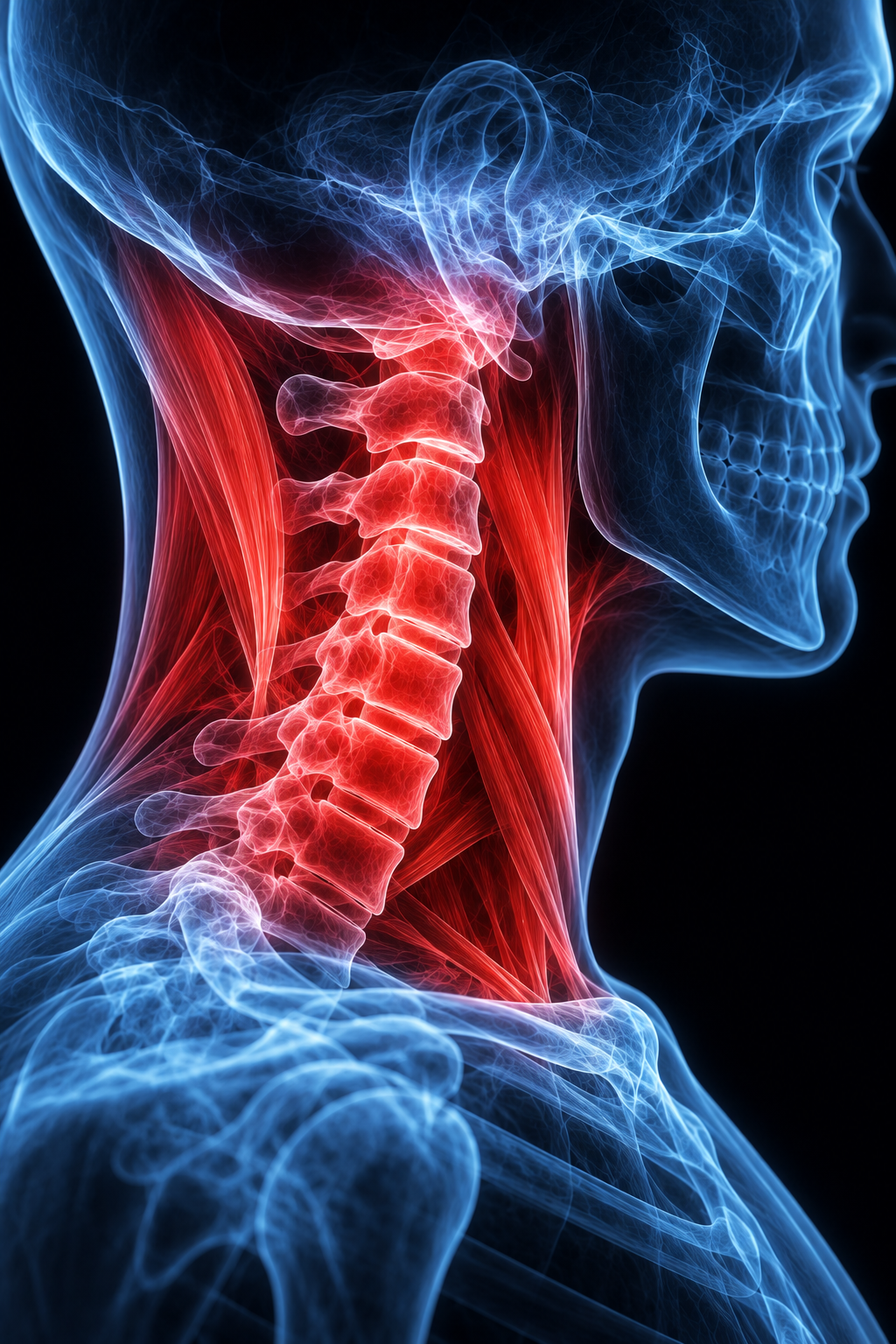
What's received significantly less attention than equipment and rules is one of the few modifiable biological variables between a player and the forces transmitted to their brain: neck strength. A growing body of research suggests that cervical musculature plays a measurable role in attenuating head impact forces — and that deficits in neck strength represent a trainable, largely underaddressed risk factor at every level of the sport.
At KRU Physical Therapy + Performance Lab, we work with football athletes across youth, high school, and collegiate levels. The relationship between neck strength and head impact exposure is more nuanced than "stronger neck equals safer head," but the evidence is clear enough to make cervical strengthening a standard part of any serious football injury prevention program.
01 | How Head Impacts Cause Concussion
Concussion is a functional brain injury — not a structural one visible on standard imaging — produced by biomechanical forces transmitted to the brain through direct or indirect impact. Understanding how those forces work is the foundation for understanding why neck strength matters at all.
Linear vs. Rotational Acceleration
When the head is struck, two types of acceleration occur simultaneously. Linear acceleration — movement of the head in a straight line — is associated with focal brain injuries like contusion and hematoma. Rotational acceleration — spinning or twisting of the head about its center — is considered the primary mechanism behind concussion, as it creates multidirectional shear strain fields in the brain's white matter. Research has found that a 50% concussion probability is associated with roughly 21% strain level in the corpus callosum — and it's rotational, not linear, acceleration that most consistently drives that strain.
This distinction matters for neck strength because the cervical musculature's most important role in head impact protection isn't simply absorbing force — it's controlling head motion and limiting the rotational acceleration that transmits to the brain after impact. A neck that can actively resist and decelerate rotational head movement provides a level of protection that a helmet alone cannot replicate.
The Neurometabolic Cascade
When sufficient force reaches the brain, it triggers a complex neurometabolic cascade — ionic imbalances, disrupted glutamate regulation, mitochondrial dysfunction, and impaired cerebral blood flow — that produces the functional deficits of concussion. The severity of this cascade is influenced by the magnitude of the mechanical force transmitted to the brain. Anything that reduces that transmission — including a stronger, more actively stabilized neck — reduces the input to the cascade, even if it can't eliminate it entirely.
02 | What the Research Shows on Neck Strength and Concussion Risk
The relationship between neck strength and head impact kinematics has been studied across multiple sports — football, soccer, rugby, and hockey — with consistent directional findings, though the overall evidence base is still developing and the relationship is more complicated than a simple linear dose-response.
The Core Finding
Research on collegiate athletes found that weaker mean neck strength was significantly associated with concussion, and that for every pound of neck strength gained, an athlete's probability of sustaining a concussion decreased by approximately 5%. A separate systematic review and meta-analysis published in the Journal of Orthopaedic and Sports Physical Therapy confirmed a meaningful association between neck strength and sports-related concussion risk across team sports. A 2025 study published in Physical Therapy in Sport identified neck strength deficit as an independent risk factor for concussion in high school sports specifically.
Reduced head acceleration Enhanced neck strength — particularly in extension and lateral flexion — has been associated with decreased peak linear and rotational head acceleration following impact. Individuals with higher neck strength measurements consistently show lower head accelerations on impact in biomechanical testing.
Anticipatory co-contraction When athletes anticipate an impact and pre-activate their neck musculature, the pre-stiffened cervical column significantly limits head motion compared to unexpected contact. Research on anticipated versus unanticipated impacts consistently shows lower linear and rotational accelerations in the anticipated condition — and neck strength determines how effective that anticipatory response can be.
What the Research Doesn't Yet Confirm
It's important to represent this area honestly. The association between neck strength and concussion risk is well-supported by biomechanical evidence and observational data, but direct evidence that neck strengthening programs specifically reduce concussion incidence in football players remains limited. Most studies are cross-sectional or observational, meaning they identify relationships rather than proving causation. A systematic review published in 2025 concluded the evidence base is promising but that more high-quality prospective randomized controlled trials are needed before definitive clinical recommendations can be made. The finding that neck strength is an independent risk factor — and that strength gains correlate with reduced head acceleration on impact — is the foundation the clinical recommendation rests on, not yet large-scale prevention trial data.
03 | The Female Athlete and Youth Athlete Gaps
Two populations carry disproportionate neck-strength-related concussion risk that are increasingly recognized in the research: female athletes and young athletes early in development.
Female Athletes and Neck Strength
In sex-comparable sports — where both male and female athletes play the same sport under the same rules — female athletes consistently sustain concussions at higher rates. In soccer, for example, girls sustain 8.4 concussions per 10,000 athletic exposures compared to 3.5 for boys. Girls have a 1.5-times higher concussion risk than boys across comparable sports, with a larger proportion of recurrent concussions. One consistently identified contributing factor is that female athletes, on average, have less-developed neck musculature relative to head mass than male counterparts — meaning the cervical musculature is providing less attenuation of head acceleration for the same impact force. This makes neck strength development a particularly high-yield intervention in female athlete populations, including female football players at the flag and tackle levels.
Youth Athletes and Neck Development
Youth football players under age 14 have a substantially lower concussion incidence than high school players (4.6 per 100,000 exposures vs. 9.6 per 10,000 athlete-exposures at the high school level) — partly because of lower force generation and partly because of reduced exposure. However, youth athletes also have the least-developed cervical musculature relative to head size, meaning the neck is doing the least work at an age when foundational strength habits are being established. Introducing age-appropriate neck strengthening early — before high school, when contact intensity and mass increase substantially — builds the cervical capacity that protection depends on at higher levels.
04 | Neck Strength Across Positions and Directions
Not all neck strength is equally relevant to head impact protection in football, and not all positions carry the same exposure profile. Research has begun to establish which directions of cervical strength matter most and which athletes need the most attention.
| Neck Strength Direction | Why It Matters in Football | Most Relevant Positions |
|---|---|---|
| Flexion | Resists backward head motion on frontal impacts; critical for limiting extension-based rotational acceleration | Linemen, linebackers — high frontal contact frequency |
| Extension | Resists forward head motion; important for rear and tackle-initiated impacts | Running backs, defensive backs — tackled from behind |
| Lateral flexion (both sides) | Controls head motion during lateral impacts — the direction most associated with concussion in biomechanical modeling | All positions — lateral impacts are common across the field |
| Rotational control | Limits angular head acceleration — the primary biomechanical driver of concussion | All positions; rotational acceleration occurs across all impact types |
Research on anterolateral eccentric impacts found that maximum average rotational acceleration can be 4.75 times higher than for anterior central impacts — suggesting that lateral and oblique impacts are biomechanically more dangerous than straight-on contact, and that lateral flexion strength is among the most important cervical qualities to develop. Asymmetries between left and right lateral flexion strength are also common in football athletes and represent a specific training gap worth addressing.
05 | What Cervical Strengthening Programs Look Like
The most commonly studied and clinically recommended approach to neck strengthening for concussion risk reduction involves progressive isometric and dynamic resistance training targeting all four primary directions of cervical motion — flexion, extension, and bilateral lateral flexion — with attention to symmetry between sides.
Key Training Principles
Research on 16-week neck strengthening programs in youth athletes demonstrated notable improvements in neck strength across all measured directions, with female athletes showing particularly large relative gains in extension and flexion — the directions where they carry the greatest initial deficits. This suggests that consistent, progressive cervical training can meaningfully close the neck-strength gap that contributes to elevated concussion risk in female and younger athletes.
Anticipatory co-contraction training — teaching athletes to actively brace the cervical musculature before expected contact — has shown measurable reductions in head acceleration in laboratory settings. In a sport context, this translates to coaching athletes to "set" the neck before initiating or receiving a tackle, rather than having relaxed cervical musculature at the moment of impact.
06 | Putting This Into Practice
Neck strength training for football athletes is practical, low-cost, and requires no specialized equipment beyond bands or a partner for manual resistance. The barrier to implementation is primarily awareness, not logistics.
- Include cervical strengthening in your off-season and in-season training — flexion, extension, and both lateral directions, targeting symmetry between left and right.
- Practice anticipatory neck bracing before contact drills. The benefit of neck strength depends in part on the muscle being pre-activated before impact — not relaxed at the moment of contact.
- Report symptoms early. High school athletes underreport concussions at rates of 30–50%, often to avoid being removed from competition. Unreported concussions that lead to return-to-play before full recovery carry substantially higher risk for more severe second injuries.
- Integrate neck strengthening into strength and conditioning programs as a year-round standard, not a supplemental add-on. The 5% concussion risk reduction per pound of neck strength gained is cumulative — small consistent gains across a full program produce meaningful protection over a season.
- Pay particular attention to female athletes and young athletes whose cervical development lags their participation intensity. These are the populations where neck strength deficits are most prevalent and where the relative benefit of targeted training is highest.
- Address lateral flexion symmetry specifically — asymmetries between left and right sides are common in football players and represent a specific vulnerability that standard bilateral training may not fully address.
- Understand that no neck strength program eliminates concussion risk. It is one layer of a multi-factor prevention approach that also includes rule compliance, appropriate technique, quality equipment, and evidence-based return-to-play decision making.
The athletes who enter high-contact training blocks with the strongest, most symmetrical cervical musculature aren't guaranteed to avoid concussion — but they are biologically better positioned to attenuate the forces that cause one. That's a trainable advantage worth building consistently, starting well before the season begins.
Managing a Neck Injury or Looking to Build Cervical Strength?
At KRU Physical Therapy + Performance Lab, we help football athletes assess cervical strength deficits, address asymmetries, and build progressive neck strengthening programs as part of a comprehensive injury prevention approach — for athletes at every level. Two locations across South Florida, plus telehealth worldwide.
References
- Leung FT, et al. Neck strength deficit is a risk factor for concussion in high school sports. Physical Therapy in Sport. 2025.
- The Relationship Between Neck Strength and Sports-Related Concussion in Team Sports: A Systematic Review With Meta-analysis. Journal of Orthopaedic & Sports Physical Therapy. 2023.
- Does strengthening the cervical spine musculature enhance neck strength and reduce sports-related concussions in rugby and football players? A systematic literature review. ScienceDirect. 2025.
- A biomechanical study of neck strength and impact dynamics on head and neck injury parameters. Frontiers in Bioengineering and Biotechnology. 2025.
- Exploring the Effects of a Neck Strengthening Program on Purposeful Soccer Heading Biomechanics and Neurocognition. International Journal of Sports Physical Therapy. 2022.
- Risk Reduction of Concussion in Athletes: Do Neck Size or Neck Strength Make a Difference? American Journal of Physical Medicine & Rehabilitation. 2024.
- Kerr ZY, et al. Concussion rates and sex differences in high school athletes. Pediatrics. (Cited in Concussion Alliance, 2025.)
- Incidence and Risk of Concussions in Youth Athletes: Comparisons of Age, Sex, Concussion History, Sport, and Football Position. Archives of Clinical Neuropsychology. 2019.
- CDC comparison of youth tackle and flag football head impact exposure. ScienceInsights review. 2026.
- NFL 2022 and 2024 season concussion data. NFL Health and Safety Report. 2022–2024.