
Scapular Stability as a Risk Factor for Shoulder Impingement
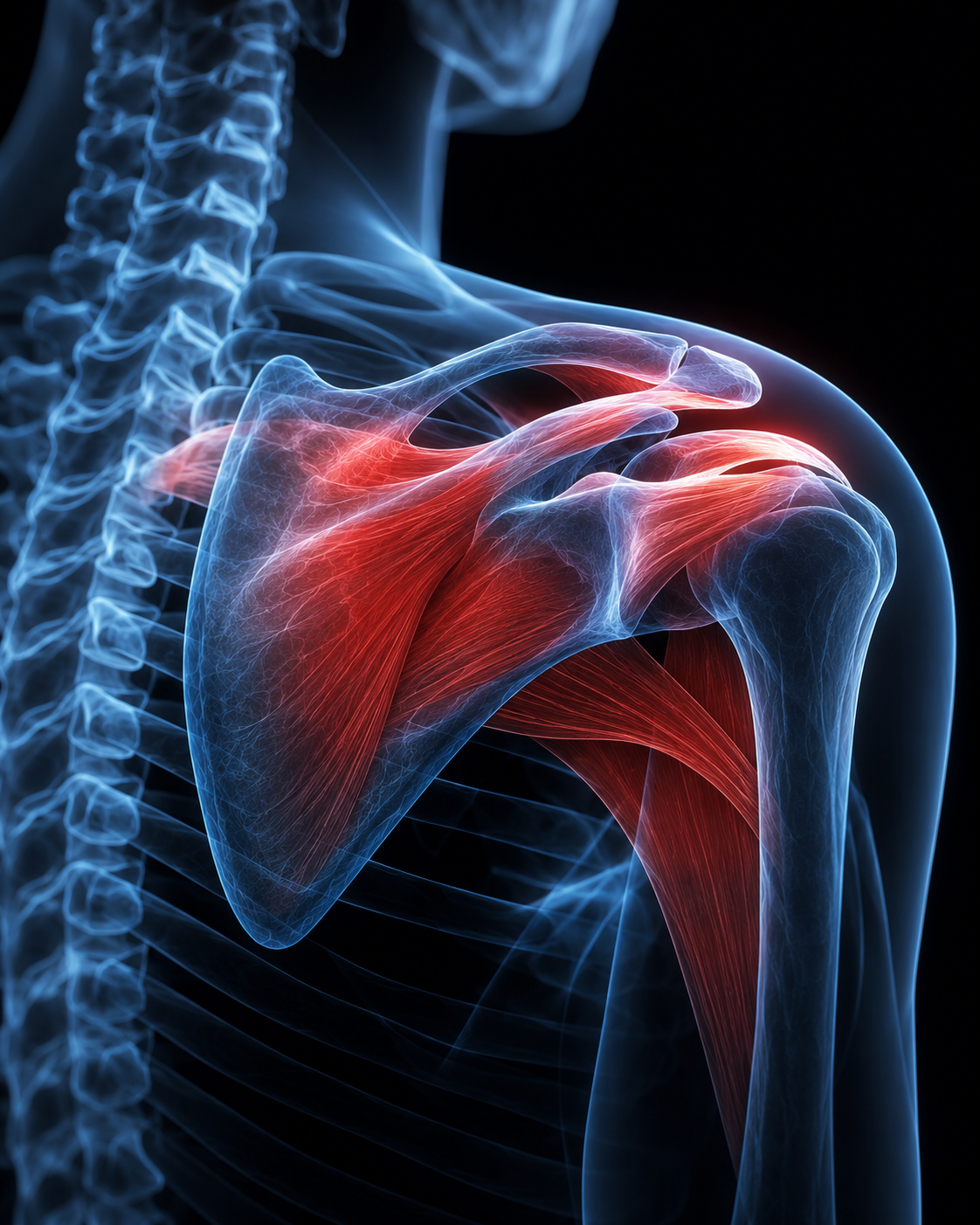
Shoulder impingement is one of the most common shoulder diagnoses in clinical practice — responsible for at least 40% of all shoulder problems seen in sports medicine and orthopedic settings. Most athletes who develop it receive some combination of rotator cuff strengthening, stretching, and activity modification. Many improve. Many also plateau, or improve only temporarily before symptoms return when training volume picks back up.
One reason impingement recurs is that treatment often focuses on the glenohumeral joint itself without adequately addressing the structure that positions it: the scapula. The scapula serves as the moving platform on which the entire shoulder complex operates. When it doesn't move well — when the muscles that control its position and rotation are weak, inhibited, or poorly coordinated — the subacromial space narrows, rotator cuff tendons get compressed, and impingement symptoms follow as a predictable mechanical consequence.
At KRU Physical Therapy + Performance Lab, we work with athletes and active individuals managing shoulder pain across a wide range of presentations. The ones who improve most durably are typically the ones whose treatment includes restoring scapular mechanics — not just addressing what hurts directly underneath the acromion.
01 | What the Scapula Actually Does
The scapula is a floating bone — attached to the thorax not by a true joint but almost entirely by muscle. That design gives it extraordinary mobility, but it means that its position and movement are entirely dependent on the muscles controlling it. When those muscles work well, the scapula moves in precise coordination with the humerus during arm elevation, providing a stable base for the rotator cuff and maintaining adequate clearance between the rotator cuff tendons and the acromion above them. When they don't, that coordination breaks down.
Scapulohumeral Rhythm: Why Timing Matters
During normal shoulder elevation, the scapula upwardly rotates, posteriorly tilts, and externally rotates in a coordinated sequence with the humerus — a relationship called scapulohumeral rhythm. This synchronized movement is what keeps the subacromial space — the gap between the rotator cuff tendons and the underside of the acromion — consistently open throughout arm elevation. When scapular movement is altered, particularly when upward rotation is reduced or the scapula anteriorly tilts during overhead motion, that space narrows. The rotator cuff tendons end up compressed against the acromion repeatedly, and impingement symptoms develop.
The Key Muscles and Why They Fail
Scapular stability is primarily maintained through the coordinated action of force couples — pairs of muscles that pull in opposing directions to produce controlled rotation. The most clinically relevant for shoulder impingement are the serratus anterior and lower trapezius, which work together to produce upward rotation and posterior tilt of the scapula during arm elevation. When the serratus anterior is weak or inhibited, the scapula fails to upwardly rotate adequately and may wing medially off the thorax. When the lower trapezius is underactivated relative to the upper trapezius — a common imbalance in overhead athletes and people who spend extended time at a desk — the scapula tends to anteriorly tilt, directly reducing subacromial space.
Research using neuroimaging has found that individuals with shoulder impingement syndrome demonstrate measurably different corticospinal organization of the lower trapezius and serratus anterior compared to healthy controls — decreased excitability, increased inhibition, and altered motor representation. In other words, the neural system controlling scapular stabilization is itself disrupted in symptomatic individuals, not just the muscles in isolation. This has real implications for treatment: simply prescribing strengthening exercises without addressing the motor control component often produces incomplete results.
02 | Scapular Dyskinesis: What It Is and What the Research Says
Scapular dyskinesis refers to altered position or motion of the scapula during both static and dynamic states. It can present as scapular winging, excessive anterior tilting, reduced upward rotation, or asymmetrical movement patterns between sides. It's identified clinically through dynamic assessment — watching how the scapula moves during arm elevation and lowering — rather than through imaging.
How Common It Actually Is
Research has found scapular dyskinesis in approximately 46% of athletes across studies — including a meaningful proportion who are completely asymptomatic at the time of assessment. This high background prevalence in asymptomatic individuals is one reason the research on scapular dyskinesis as a risk factor is more nuanced than a simple "dyskinesis causes impingement" framing.
The Mechanical Consequence That Matters Most
Regardless of where the research lands on risk ratios, the mechanical relationship between scapular position and subacromial space is well established. Reduced upward rotation, anterior tilting, and decreased posterior tilt of the scapula have all been consistently associated with decreased subacromial clearance during arm elevation. For an athlete performing hundreds of overhead movements per session, each repetition through a narrowed subacromial space is cumulative tissue load on the rotator cuff tendons and bursa. That's the mechanism impingement researchers have been most confident about — not that dyskinesis alone guarantees injury, but that it reliably makes the mechanical environment worse.
03 | Who Is Most at Risk
Scapular stability deficits and impingement symptoms don't develop equally across all athletes and activities. Several populations and movement patterns carry consistently higher exposure.
| Population / Pattern | Why Scapular Stability Is at Risk |
|---|---|
| Overhead athletes (pitchers, volleyball, tennis, swimmers) | Repetitive high-load overhead motion fatigues the serratus anterior and lower trapezius, gradually disrupting scapulohumeral rhythm with accumulated volume |
| Desk workers and people with sedentary postures | Prolonged rounded shoulder posture reduces lower trapezius activity and tightens the pectoralis minor, chronically altering resting scapular position and available posterior tilt |
| Athletes returning from rotator cuff injury | Pain inhibition disrupts normal muscle recruitment patterns; the scapular stabilizers are frequently underactivated as a protective response that persists after pain resolves |
| Athletes with pectoralis minor tightness | A tight pectoralis minor directly restricts scapular posterior tilt and upward rotation — one of the most common and underaddressed contributors to anterior tilt during overhead movement |
| Young athletes in early specialization | High repetition volume without adequate strength development across the full scapular stabilizer system — the serratus anterior in particular is frequently underdeveloped in young overhead athletes |
04 | What Rehabilitation Should Address
Scapular-focused rehabilitation for shoulder impingement consistently outperforms approaches that address the glenohumeral joint alone. A randomized controlled trial comparing standard physiotherapy to physiotherapy plus scapular stabilization exercises found that the scapular stabilization group achieved significantly better outcomes at 12 weeks — lower pain at rest, during movement, and at night, and better functional shoulder scores — compared to the control group receiving standard care alone.
The Muscles That Need the Most Attention
The serratus anterior and lower trapezius are the primary targets in scapular stabilization rehabilitation because they're the most consistently inhibited in impingement populations and the most mechanically critical for maintaining subacromial space. The upper trapezius, by contrast, tends to be overactive relative to the lower — a muscle ratio imbalance that produces the anterior tilt and reduced upward rotation that narrow the space the rotator cuff moves through.
Effective exercise selection for scapular rehabilitation emphasizes exercises that preferentially activate the lower trapezius and serratus anterior while minimizing compensatory upper trapezius recruitment. Wall slides, prone Y exercises, serratus punches, and push-up plus variations are among the exercises with the best evidence for achieving this activation ratio.
Pectoralis Minor Flexibility
The pectoralis minor originates on the coracoid process of the scapula and inserts on the ribs. When it's tight, it pulls the scapula into anterior tilt and internal rotation — directly opposing the posterior tilt and upward rotation the serratus anterior and lower trapezius are trying to produce. Restoring pectoralis minor length is frequently a prerequisite for scapular stabilization exercises to produce their intended mechanical effect. Strengthening the lower trapezius against a restricted anterior tilt is like trying to open a door while someone pushes it closed from the other side.
05 | Putting This Into Practice
Shoulder impingement that recurs or plateaus with standard rotator cuff rehabilitation usually has a scapular component that wasn't fully addressed. The goal isn't to treat the scapula in isolation — it's to ensure the scapular stabilizers are doing their share of the work before asking the rotator cuff to manage forces it shouldn't have to handle alone.
- If shoulder impingement symptoms keep returning despite rotator cuff exercises and stretching, ask whether your scapular mechanics have been assessed — not just your glenohumeral mobility and cuff strength.
- Address pectoralis minor tightness consistently if you spend significant time in rounded postures or do high volumes of pressing movements — it's one of the most predictable mechanical contributors to anterior tilt.
- Build serratus anterior and lower trapezius activation into your warm-up, not just your rehabilitation. These muscles are the first line of defense for subacromial clearance and the first to be inhibited under fatigue.
- Pay attention to scapular symptoms during volume spikes — a sudden increase in overhead training load is one of the most common triggers for scapular stabilizer fatigue and the symptoms that follow.
- Overhead athletes — particularly pitchers, volleyball players, swimmers, and tennis players — should have their scapular mechanics assessed as part of routine preseason screening, not only when pain develops.
- Scapular stabilization exercises belong in strength and conditioning programs year-round, not only in rehabilitation settings. Serratus anterior and lower trapezius work is shoulder health maintenance for any overhead athlete.
- Be cautious with rapid increases in overhead volume during training camps, preseason ramp-ups, or multi-day tournaments — scapular stabilizer fatigue accumulates with volume and is often the first thing to break down before impingement symptoms appear.
The shoulder is a system. The rotator cuff and the scapular stabilizers work together to keep the subacromial space open and the joint mechanics healthy under load. When one part of that system is undertrained or inhibited, the rest compensates — and impingement is often what the compensation looks like over time.
Dealing With Shoulder Pain That Keeps Coming Back?
At KRU Physical Therapy + Performance Lab, we assess scapular mechanics, rotator cuff function, and overhead movement quality to identify and address the root causes of shoulder impingement — for athletes and active individuals at every level. Two locations across South Florida, plus telehealth worldwide.
References
- Hogan C, Corbett JA, Ashton S, et al. Scapular dyskinesis is not an isolated risk factor for shoulder injury in athletes: a systematic review and meta-analysis. Am J Sports Med. 2021;49(10):2843–2853.
- Hickey D, et al. Scapular dyskinesis increases the risk of future shoulder pain by 43% in asymptomatic athletes: a systematic review and meta-analysis. Br J Sports Med. 2018.
- Effect of scapular stabilization and mobilization-based rehabilitation on pain and shoulder function in subacromial impingement syndrome: a randomized controlled trial. PMC. 2025.
- Altered corticospinal excitability of scapular muscles in individuals with shoulder impingement syndrome. PMC. 2022.
- Kinesiologic considerations for targeting activation of scapulothoracic muscles — part 1: serratus anterior. PMC. 2019.
- Prevalence and grade of scapular dyskinesis in patients with shoulder injuries: a cross-sectional study. ScienceDirect. 2026.
- Clarsen B, et al. Reduced glenohumeral rotation, external rotation weakness and scapular dyskinesis are risk factors for shoulder injuries among elite male handball players. Br J Sports Med. 2014;48(17):1327–1333.
- Burn MB, et al. Prevalence of scapular dyskinesis in overhead and nonoverhead athletes: a systematic review. Orthop J Sports Med. 2016.
- Shoulder Function: Enhancing Scapular Stabilization. NASM Blog. 2024.
- Shoulder Instability, Dysfunction and Scapular Dyskinesis. PM&R KnowledgeNow. 2024.