
Monitoring In-Season Training Load to Reduce Iliopsoas Strain
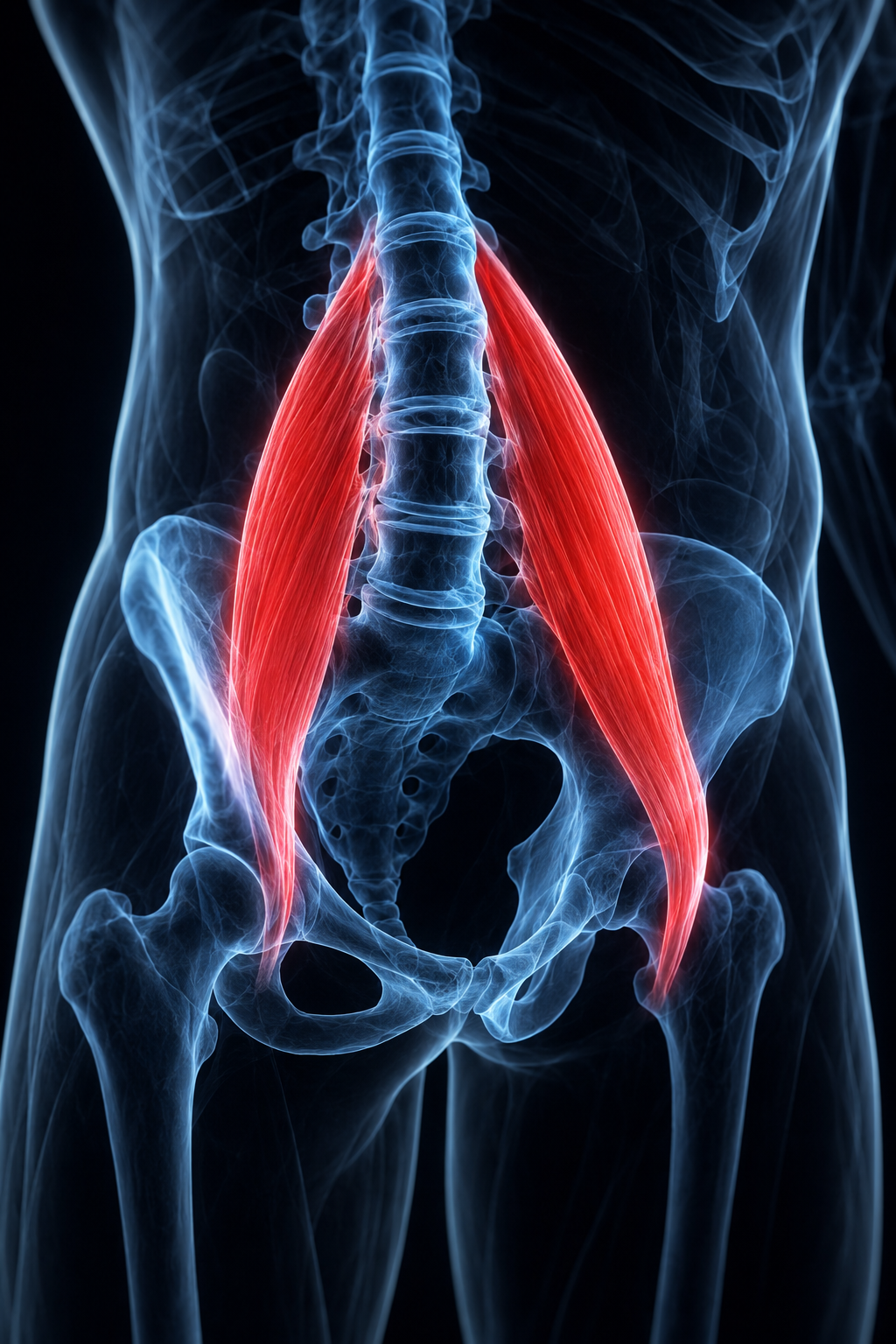
Iliopsoas strains are one of the more predictable injuries in sport — not because they're unavoidable, but because the conditions that produce them follow a recognizable pattern. Load spikes too fast. Recovery doesn't keep pace. The hip flexor, already working hard through a dense schedule of sprinting, acceleration, and repetitive hip drive, hits the point where tissue demand exceeds tissue tolerance. The result is an injury that sidelines athletes for weeks and, when managed poorly, comes back.
Hip flexor pathology accounts for 5% to 28% of injuries in high-risk sport-specific populations depending on the sport — a wide range that reflects how differently these injuries are classified and reported, but also how common they are across disciplines. Sprinters, soccer players, basketball players, swimmers, and field sport athletes all face meaningful iliopsoas injury risk, and most of them share the same underlying exposure: repetitive, high-velocity hip flexion under load, without adequate monitoring of how much cumulative stress is accumulating over the course of a week, a month, or a season.
At KRU Physical Therapy + Performance Lab, we work with athletes across a wide range of sports managing hip flexor pain and iliopsoas-related injuries. The most consistent theme in athletes who develop in-season strains isn't poor mechanics or inadequate strength — it's a workload management problem that was visible in the data before the injury happened.
01 | What the Iliopsoas Does and Why It Gets Strained
The iliopsoas is the primary hip flexor — a combination of two muscles, the iliacus and the psoas major, that originate from the lumbar spine and inner pelvis and insert onto the lesser trochanter of the femur. Its primary function is to bring the thigh toward the trunk, but it also plays a significant role in stabilizing the lumbar spine and controlling pelvic position during dynamic movement.
Why This Muscle Is Vulnerable In-Season
During sprinting, the iliopsoas fires eccentrically during the swing phase to decelerate hip extension and then concentrically to drive the knee forward into the next stride. At high velocities, this cycle repeats dozens of times per minute, placing sustained demand on a muscle that has relatively limited recovery time between high-intensity sessions during a competitive season. Unlike the hamstrings — which have received extensive research attention and standardized return-to-sport protocols — the iliopsoas is frequently undertested and undermonitored until it becomes symptomatic.
Strains occur when muscle fibers are overloaded beyond their capacity to absorb force. This can happen acutely — a sudden sharp pull during acceleration or a forceful change of direction — or gradually, as repetitive submaximal loading accumulates without adequate recovery, leading to progressive microtearing at the musculotendinous junction. Both presentations are workload-related at their root. The acute injury happens to a tissue that was already fatigued. The gradual injury happens to a tissue that was never given enough time to adapt.
Two Presentations, One Underlying Problem
Iliopsoas pain usually shows up in one of two ways. The first is an acute strain — a sharp pull felt during sprinting, acceleration, or a powerful kicking motion, with immediate pain reproduced on resisted hip flexion. The second is a more gradual pattern, where the front of the hip becomes progressively stiffer after sitting, more sensitive with knee drive, and consistently sore in the hours following high-intensity training. Both presentations point to the same underlying issue: the muscle's mechanical tolerance has been exceeded, either suddenly or cumulatively.
02 | How In-Season Load Creates Injury Risk
The relationship between training load and injury risk is well established in sports science, and the iliopsoas is particularly sensitive to it during the competitive season — when training volume is expected to taper but competition load remains high, and where schedule density can quietly accumulate more stress than athletes, coaches, or athletic trainers realize.
Acute vs. Chronic Load: The Core Concept
Chronic load reflects what an athlete's tissue has been conditioned to tolerate over weeks of consistent training — their baseline capacity. Acute load reflects what's being demanded in the most recent stretch of activity — their current fatigue. When acute load spikes dramatically above what the chronic baseline has prepared for, injury risk rises. The tissue hasn't had the time to build the tolerance the new workload requires.
Abrupt spikes in acute load — not high chronic loads — are most strongly associated with non-contact soft tissue injury in the research.
When the Season Creates Hidden Load Spikes
In-season load management is harder than preseason load management because the schedule is largely fixed. A tournament weekend, a stretch of back-to-back competitions, or a travel week that compresses training into fewer days can all generate acute load spikes that aren't visible in practice session data alone. Match load — the intensity and volume of game minutes — must be counted alongside training load to get an accurate picture of what the iliopsoas is actually absorbing. Athletes who appear to be training lightly while playing heavily are often carrying a much higher ACWR than their practice log suggests.
Preseason Ramp-Ups and Return From Rest
Two other high-risk windows for iliopsoas strain stand out consistently. The first is the preseason ramp-up, when athletes transition from a relatively low training stimulus during the off-season to a high-volume, high-intensity preseason block before the tissue has rebuilt the chronic load baseline needed to absorb it. The second is return from a break — whether a short holiday, an illness absence, or a recovery week — where the chronic baseline has dropped while the athlete's perceived readiness remains high. Both scenarios create the same condition: an acute load that significantly exceeds a lower-than-expected chronic foundation.
03 | Grading Iliopsoas Strains and What They Mean for Return to Sport
Not all iliopsoas strains are the same, and the grade of injury has meaningful implications for return-to-sport timelines, rehabilitation approach, and re-injury risk if the athlete comes back before the tissue has adequately recovered.
| Grade | Description | Typical Presentation | Return Timeline |
|---|---|---|---|
| Grade 1 | Minor fiber disruption, muscle structurally intact | Mild anterior hip tightness, pain with resisted hip flexion but no significant strength loss | 1–3 weeks with active rehab |
| Grade 2 | Partial muscle or tendon tear | More significant pain, measurable weakness on resisted hip flexion, possible bruising | 4–8 weeks; longer if return is rushed |
| Grade 3 | Complete rupture of the muscle or tendon | Severe pain, significant functional loss, often inability to perform resisted hip flexion against gravity | 3–6 months; surgical consultation may be indicated |
| Tendinopathy / Gradual onset | Chronic repetitive overload without acute event, often at the musculotendinous junction | Stiffness after sitting, anterior hip ache worsening with training volume, no acute incident | 6–12+ weeks of progressive loading |
An important clinical distinction: MRI findings matter for return-to-sport decision making. Research has found that MRI findings indicating true muscle strain are associated with a significantly lower return-to-play rate compared to presentations showing peritendinitis changes. In borderline or high-grade cases, imaging before clearing an athlete provides important information that clinical testing alone may miss.
04 | What Monitoring Actually Looks Like in Practice
Effective in-season monitoring doesn't require GPS technology or a dedicated sports science team — though both help. At its most accessible, it requires tracking enough information to identify when an athlete's workload has spiked relative to their recent baseline, and responding proactively before symptoms develop.
What to Track
For teams or individual athletes without access to wearable technology, session RPE (Rate of Perceived Exertion) multiplied by session duration provides a practical internal load score that can be logged daily and used to calculate a simple ACWR. For athletes with access to GPS or heart rate monitors, external load metrics — distance covered, high-speed running volume, acceleration and deceleration counts — provide a more precise picture of what the hip flexors specifically are absorbing.
Example: 60-minute practice at RPE 7 = 420 load units. Track this daily, rest days = 0.
Early Warning Signs That Precede a Strain
Athletes rarely strain the iliopsoas without warning — the warning signs are simply often ignored or misattributed to normal fatigue. A pattern of increasing anterior hip stiffness after sitting, progressive tightness during warm-up that doesn't resolve, reduced hip drive during acceleration, or mild discomfort on resisted knee lift are all early signals worth taking seriously. Addressed at this stage, they typically resolve with one to two days of reduced loading and targeted soft tissue work. Ignored, they progress to a strain that sidelines the athlete for weeks.
05 | Putting This Into Practice
Reducing in-season iliopsoas strain risk is less about any single exercise or intervention and more about maintaining a consistent relationship between what the tissue is being asked to do and what it's been prepared to handle.
- Track your training load week to week, even informally. A simple RPE-based log takes under a minute per session and gives you the data to recognize a spike before it becomes an injury.
- Pay attention to anterior hip stiffness after sitting or during early warm-up. This is often the first signal that load has outpaced recovery, not just normal tightness.
- Be especially careful during tournament weekends, travel stretches, and the weeks immediately after returning from a break — these are when ACWR spikes most often occur without anyone noticing.
- Include hip flexor and core strengthening work consistently throughout the season, not just in preseason — tissue tolerance built in August doesn't automatically carry through March without maintenance.
- Count match load in your weekly ACWR calculations, not just practice load. An athlete playing heavy minutes is carrying a much higher actual workload than practice logs alone reflect.
- Plan proactive recovery sessions — reduced intensity, lower volume — in the 48 hours following a high-load match or tournament weekend, rather than maintaining normal training load through a dense schedule.
- Identify your highest-risk athletes early: those returning from any period of rest, those in the first weeks of preseason, and those with a prior history of anterior hip pain all warrant closer monitoring.
- Treat early anterior hip complaints seriously rather than as normal fatigue. An athlete reporting stiffness, tightness, or mild pain during hip drive activities is often two to three weeks from a strain if the load continues unchanged.
The athletes who make it through a full season without iliopsoas issues aren't usually the ones with the most flexibility or the best preseason conditioning scores. They're the ones whose workload was managed intelligently enough that the tissue never got far enough ahead of its recovery to break down.
Dealing With Hip Flexor Pain or Recurring Anterior Hip Tightness?
At KRU Physical Therapy + Performance Lab, we help athletes identify and address iliopsoas-related hip pain through load management, progressive rehabilitation, and return-to-sport planning — for athletes at every level, across every sport. Two locations across South Florida, plus telehealth worldwide.
References
- Serner A, et al. Hip Flexor Injuries in the Athlete. Curr Rev Musculoskelet Med. PubMed. 2021.
- Psoas Syndrome. StatPearls. NCBI Bookshelf. Updated May 2025.
- Acute to Chronic Workload Ratio (ACWR) for Predicting Sports Injury Risk: A Systematic Review and Meta-analysis. PMC. 2025.
- Load Management and Injury Prevention in Elite Athletes: A Narrative Review. Premier Science. 2025.
- Player Monitoring in Professional Soccer: Spikes in Acute:Chronic Workload Are Dissociated From Injury Occurrence. PMC. 2020.
- Understanding and treating anterior hip injuries: Pro soccer case study. Sportsmith. 2024.
- Monitoring and training for hip and groin health in-season. Sportsmith. 2026.
- Hip Flexor Strain: Return-to-Sprint Timeline and Tests. Helix Sports Medicine. 2026.
- Iliopsoas Pain Explained: A PT's Guide to Your Hip Flexor. High Bar Health. 2026.