
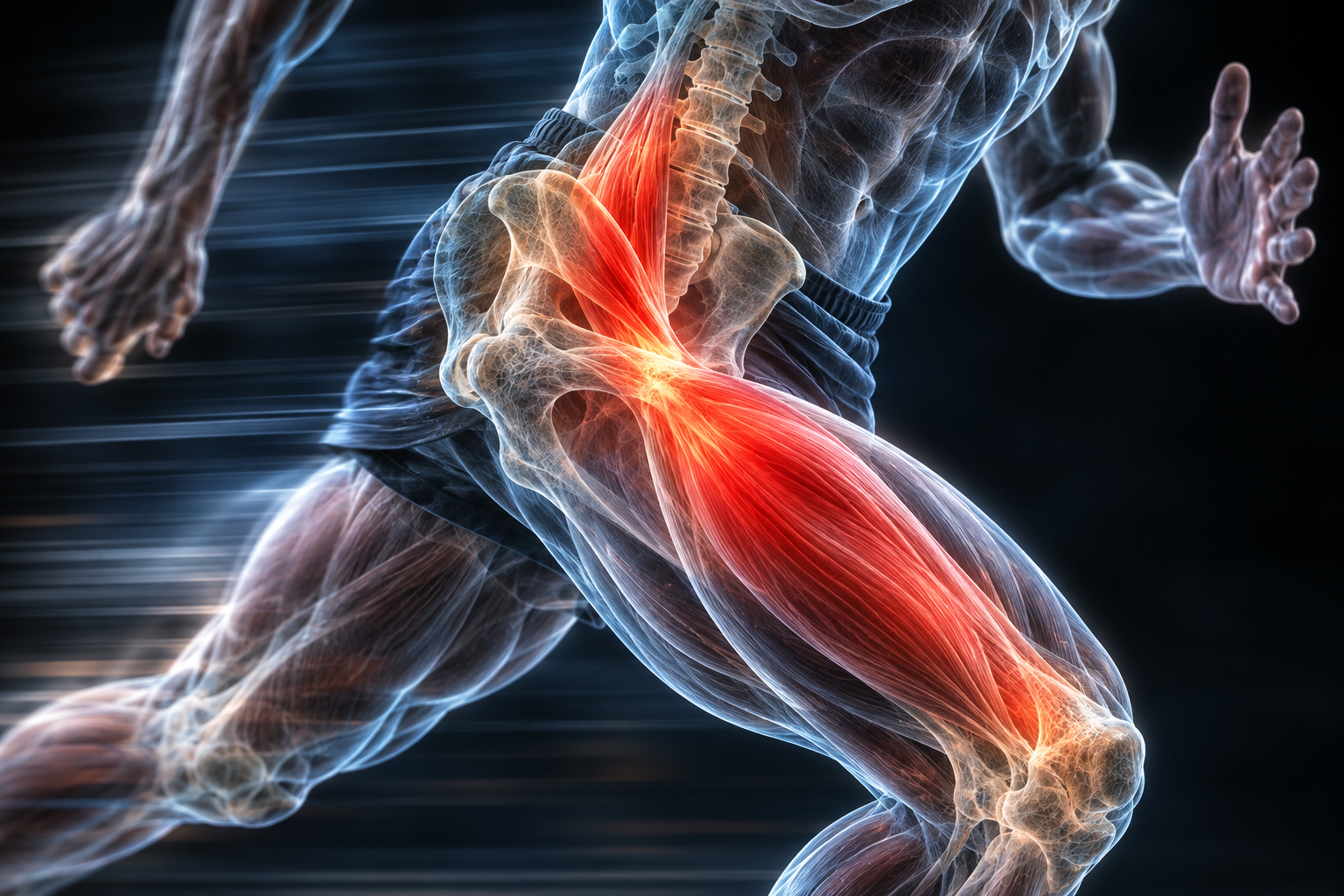
Hip flexor strains are one of the most frustrating injuries in sport. They're common, they're often underestimated, and they recur at a rate that suggests most athletes never actually address what caused them in the first place. At the elite level, hip flexor strains account for a significant proportion of soft tissue injuries in sprinters, kickers, and field sport athletes — and the reason comes down to a biomechanical demand that is specific to those movement patterns: the explosive, end-range contraction of a muscle group that most athletes spend no time specifically training.
The hip flexors are not a single muscle. They are a group — the iliopsoas (iliacus and psoas major), rectus femoris, and several smaller contributors — that collectively produce hip flexion and are involved in every stride, every acceleration, and every kick. Understanding which part of that group fails, in which phase of the movement, and why, is what separates an athlete who recovers fully and prevents recurrence from one who keeps getting the same injury every preseason.
01 | The Hip Flexors Under Load: What Sprinting and Kicking Demand
The Sprinting Mechanism
During maximum velocity sprinting, the hip flexors do something that most people don't consider: they work eccentrically. In the late swing phase — as the leg reaches forward and then decelerates before ground contact — the hip extensors fire to slow the hip and prepare for stance. The hip flexors, particularly the iliopsoas, must generate force in a lengthened position to control that deceleration and then concentrically contract again to drive the thigh forward in the next stride cycle. At maximum velocity, this cycle happens at over four strides per second.
This is the mechanical environment in which hip flexor strains occur in sprinters: a muscle being asked to generate high force at a long length, repeatedly, at high speed, without adequate preparation or sufficient eccentric strength. The strain almost always occurs at or near the musculotendinous junction — the transition zone between the muscle belly and the tendon — which is the most mechanically vulnerable point during eccentric loading.
The Kicking Mechanism
In kicking sports — soccer, American football, Australian rules football — the hip flexor demand is different but equally high. The kick involves a rapid, forceful hip flexion contraction from an extended hip position. The power comes from the stretch-shortening cycle: the hip is taken into extension during the backswing, loading the hip flexors eccentrically, and then those same muscles must concentrically contract explosively to drive the leg through. The rectus femoris is particularly involved in kicking — it crosses both the hip and the knee, contributing to both hip flexion and knee extension in the follow-through phase.
Strains in kickers most often affect the proximal rectus femoris or the iliopsoas at the musculotendinous junction, occurring in the terminal backswing or at ball contact — the moment of maximal eccentric load followed immediately by explosive concentric demand. Full-power kicks at a cold muscle or without adequate neural preparation are the highest-risk scenarios.
02 | Grading and Presentation: What the Strain Feels Like
- Grade I (Mild strain): Minor disruption of muscle fibers. The athlete feels a sharp pull in the groin or front of the hip, often mid-stride or at ball contact. They can usually continue the activity but are aware of the injury. Full recovery in 1–2 weeks with appropriate management.
- Grade II (Partial tear): More significant fiber disruption. The athlete often has to stop — the pain prevents continuation of the activity at intensity. There may be localized swelling, palpable tenderness in the proximal thigh or inguinal region, and pain with active hip flexion against resistance. Recovery typically takes 3–6 weeks.
- Grade III (Complete tear): Full thickness rupture. Rare in the hip flexors compared to hamstrings. Significant pain, weakness with hip flexion, possible bruising tracking down the anterior thigh. May require surgical consultation. Recovery 6–12 weeks or more.
03 | Why These Injuries Keep Coming Back
The 8.7% recurrence rate for hip flexor strains in NCAA football is almost certainly an underestimate at the general athletic population level, where rehabilitation is less structured. The reason recurrence is so common comes down to what most athletes do (and don't do) after the first strain:
- Rest and return, without eccentric reloading. Most athletes manage hip flexor strains with rest, anti-inflammatories, and passive stretching. When pain resolves, they return to full activity. This approach restores pain-free range of motion but does not restore eccentric strength — the specific capacity that failed in the first place. The tendon heals, but the mechanical vulnerability that caused the strain persists.
- Static stretching doesn't build end-range strength. The hip flexors are typically tight in athletes — especially those with desk job or long commute lifestyle off the field — which is a recognized risk factor for strain. But addressing that tightness with passive hip flexor stretches only addresses length, not the eccentric force-production capacity at end-range that is actually required during sprinting and kicking. These are fundamentally different qualities.
- Training imbalance. Most sport training programs emphasize hip extension (squats, deadlifts, glute bridges) relative to hip flexion. The hip extensors — the glutes and hamstrings — are typically stronger, better trained, and more conditioned than the hip flexors in most athletes. This imbalance contributes to the mechanical overload when the hip flexors are suddenly asked to produce maximal eccentric force in sprint acceleration or at the top of a kick.
04 | How High-Level Athletes Train to Prevent Hip Flexor Strains
Prevention programs for hip flexor strains in sprint and kicking athletes share several common components that distinguish them from generic hip flexibility work:
- Eccentric hip flexor loading is the cornerstone. Exercises that load the hip flexors in a lengthened position — such as the Copenhagen hip flexor lowering, the iliopsoas stretch-with-load, and the reverse Nordic hip flexion — build the eccentric strength that protects the musculotendinous junction during high-velocity sports movements. These are not commonly performed in standard athlete training programs, which is a gap that directly contributes to strain rates.
- Flywheel (inertial) training for the hip flexors has shown promise in research on sprint athletes because it allows the muscle to work eccentrically at speeds and loads that more closely replicate the sprint cycle. This is a tool used in professional track and field and elite soccer programs specifically for hip flexor and hamstring strain prevention.
- Graded sprint and kick progressions during the preseason are essential. Hip flexor strains spike during early preseason and in the first few weeks of a new season — the high-risk window when athletes are returning to maximum velocity work before their tissue is adequately conditioned for it. A graded sprint program that builds to full velocity over 2–3 weeks dramatically reduces this risk.
- Hip flexion strength testing with objective metrics — particularly the isometric hip flexion force on each side — allows return-to-sport decisions to be made based on data rather than symptom resolution alone. An athlete who is pain-free but has 70% of contralateral hip flexion strength is not ready to accelerate at full effort or take a full-power kick.
- A hip flexor strain that keeps coming back is not bad luck — it's a training gap. If this is the second or third time you've strained the same side, the return-to-sport process hasn't addressed what failed. That usually means eccentric hip flexor loading has never been part of your program.
- The cold kick and the first sprint of the session are the highest-risk moments. Hip flexor strains in kickers cluster around the first full-power kick of a session and around kicks taken without adequate warm-up. A specific dynamic warm-up that includes progressive hip flexion loading before full-intensity kicks is one of the most practical prevention strategies available.
- The preseason is the highest-risk window for hip flexor strains. Any program that takes athletes from low-volume off-season work to full-speed sprinting and full-power kicking in the first week of camp will produce hip flexor strains. A ramp-up protocol over at least two weeks — with progressive sprint distances and kick volumes before full-intensity sessions — is the most evidence-supported prevention strategy.
- Hip flexion isometric strength is a valid return-to-sport criterion. Symptom resolution alone is not sufficient for clearance to full-speed sprint or kicking work. Side-to-side asymmetry above 10–15% in hip flexion force production is associated with increased recurrence risk. If you have access to handheld dynamometry, this is worth measuring before return to full training.
Hip Flexor Injury Keeping You Off the Field? Let's Fix It Properly.
At KRU Physical Therapy + Performance Lab, we assess hip flexor strains with objective strength testing, identify the eccentric loading gaps that drive recurrence, and build return-to-sport programs that address the actual mechanism — not just the symptoms. Two locations in South Florida, plus telehealth worldwide.
References
- Rambaud AJM, et al. Hip flexor and hip adductor strains in National Collegiate Athletic Association sports: epidemiology, return to sport, recurrence. JATA. 2019;54(5):483–491. (28.6% prevalence, 72% noncontact, 8.7% recurrence, 66.9% return in 0–6 days.)
- UEFA Injury Study. A prospective study of hip and groin injuries in professional football over seven consecutive seasons. PubMed. 2010. (Hip and groin injury epidemiology in elite soccer.)
- NYU Langone Health. Common Hip Injuries in Soccer and Prevention. 2022. (Mechanism, prevention in soccer athletes.)
- Just Fly Sports. Strength and conditioning research on the psoas — studies on hip flexor function in sprint athletes. 2023.
- IntechOpen. Hip Flexor Injuries in Athletes. (Grading system, management, kicking mechanism.)