
Overhead lifting hurts for a lot of people — in the gym, in the pool, on the baseball diamond, and on the volleyball court. The pain is often described the same way: a catch or pinch somewhere at the front or top of the shoulder, usually around 60–120 degrees of elevation, that makes the press, the serve, or the stroke feel like it's being done against resistance that shouldn't be there. Push through it, and it fades for a session or two. Keep pushing, and eventually it doesn't fade at all.
The shoulder is the most mobile joint in the body — and that mobility comes at the cost of inherent stability. Everything that lets the shoulder move through a full overhead arc also makes it vulnerable to mechanical breakdown when the muscles that control that arc stop doing their jobs precisely. Understanding what's actually happening in a shoulder that hurts overhead isn't just anatomy trivia — it changes what you do in the gym, how you train, and whether this becomes a minor correctable problem or a progressive structural injury.
01 | The Architecture of the Shoulder: Why Overhead Is Different
The shoulder's range of motion is extraordinary compared to any other joint — it can reach above the head, behind the back, and across the body in combinations that no other joint approaches. This is possible because the glenohumeral joint, the ball-and-socket joint most people picture when they think "shoulder," has a relatively shallow socket. The glenoid (the socket) covers only about a third of the humeral head (the ball) at any given position. The joint trades bony stability for mobility, and relies on the surrounding soft tissue — the rotator cuff, the labrum, the joint capsule, and the muscles of the scapula — to keep the humeral head centered during movement.
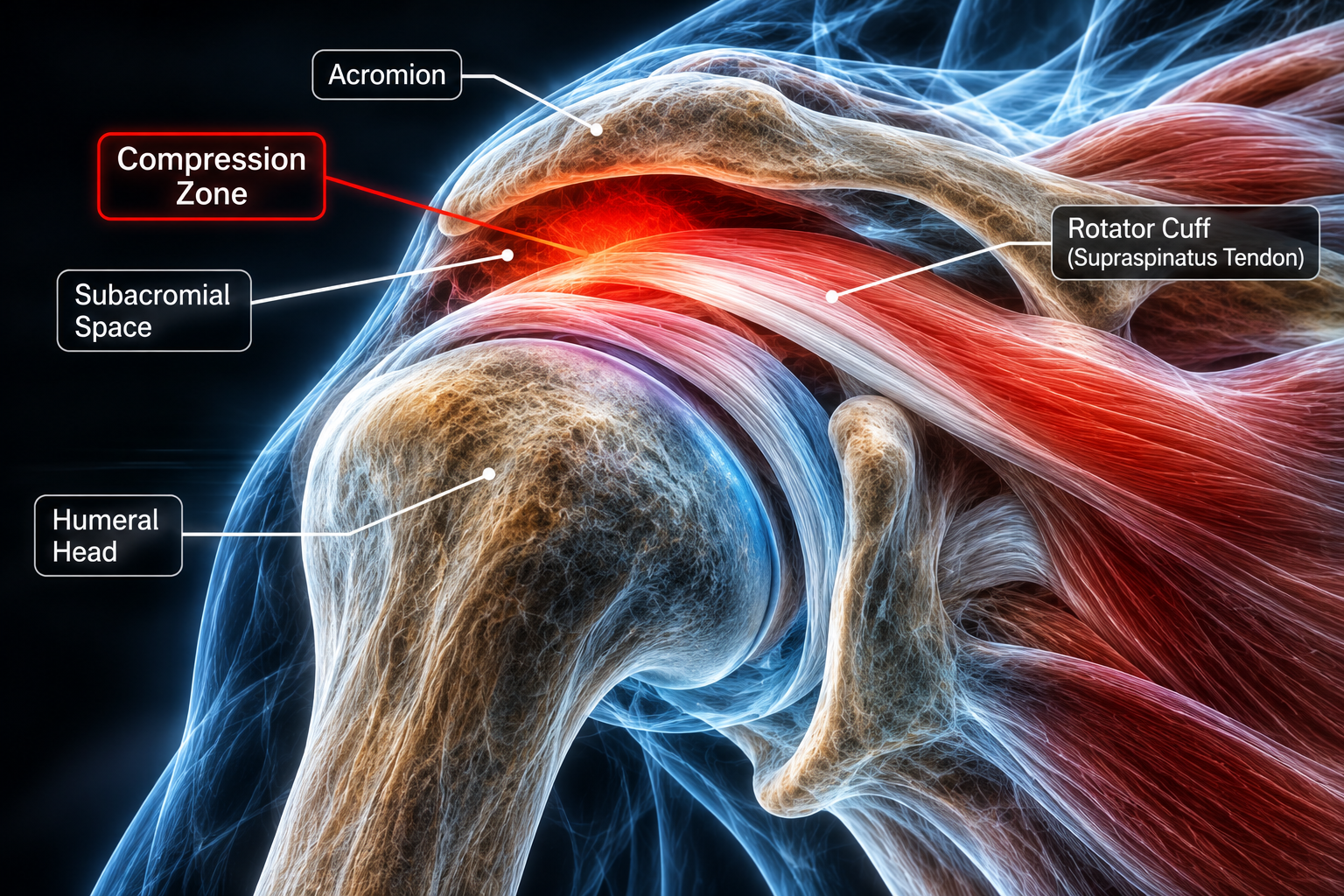
Between the top of the humerus and the acromion — the bony shelf at the top of the shoulder blade — is a narrow space called the subacromial space. Running through this space are the supraspinatus tendon (part of the rotator cuff), the subacromial bursa (a fluid-filled sac that reduces friction), and the long head of the biceps tendon. These structures have approximately 6–10mm of clearance in a healthy shoulder.
When you raise your arm overhead, the humeral head must externally rotate and depress slightly to maintain clearance in that space. If it doesn't — because the rotator cuff isn't firing correctly, the scapula isn't rotating properly, or the posterior capsule is too tight — the supraspinatus tendon and bursa get compressed between bone and bone. That's the pinch. And it gets worse the more you repeat it.
02 | What "Shoulder Impingement" Actually Means
Subacromial impingement syndrome is the clinical label for pain arising from mechanical compression of the structures in the subacromial space. It's the most common shoulder diagnosis in overhead athletes and the general active population — but calling it a diagnosis can be misleading, because impingement is a mechanism, not a single structural finding. The underlying driver varies considerably between people:
- Rotator cuff dysfunction is the most common driver. The four rotator cuff muscles — supraspinatus, infraspinatus, teres minor, subscapularis — collectively function as a dynamic depressor of the humeral head during elevation. If they're weak, fatigued, or firing out of sequence, the humeral head migrates superiorly during overhead movement and closes the subacromial space. The supraspinatus, which passes directly through this space, is the most commonly injured structure.
- Scapular dyskinesis is the failure of the shoulder blade to properly upwardly rotate as the arm elevates. The acromion is attached to the scapula — if the scapula doesn't tilt and rotate upward with overhead movement, the acromion effectively drops down toward the humerus, reducing the subacromial clearance from above. Scapular dyskinesis is extremely common in overhead athletes and is both a cause and a consequence of shoulder pain.
- Posterior capsule tightness is particularly common in throwing athletes and swimmers. When the posterior joint capsule is tight, it acts as a fulcrum — as the arm elevates, the humeral head is pushed anteriorly and superiorly rather than staying centered in the socket. This is a major driver of internal impingement in overhead athletes specifically.
- Acromial morphology was historically thought to be the primary cause of impingement — a curved or hooked acromion reducing the subacromial space structurally. The current evidence suggests this plays a smaller role than the dynamic factors above and that the same morphology can be entirely asymptomatic in well-functioning shoulders.
03 | Why Overhead Athletes Are Especially Vulnerable
The shoulder was not designed to handle the volume and velocity of a modern overhead training program. A competitive swimmer takes 500,000–1,000,000 stroke cycles per year. A baseball pitcher's shoulder rotates at up to 7,000 degrees per second during the late cocking phase of a throw — the fastest recorded movement of any joint in the human body. A volleyball player may swing 300+ times per practice session. These cumulative loads are manageable with ideal mechanics and appropriate recovery; they produce injury when either breaks down.
In overhead athletes, the specific structures most at risk are determined by sport:
- Swimmers are most vulnerable to subacromial impingement and rotator cuff tendinopathy from the combination of high volume, fatigue-driven technique breakdown, and the specific demands of the freestyle and butterfly strokes. Subacromial impingement and rotator cuff tendinopathy together account for over 50% of shoulder injuries in collegiate swimmers.
- Throwers (baseball, softball) are most vulnerable to internal impingement — a specific pattern where the undersurface of the supraspinatus and the superior labrum are compressed in the late cocking position (arm back, externally rotated). Over time, this produces partial-thickness rotator cuff tears on the undersurface of the tendon, which are notoriously difficult to identify on standard X-ray.
- Volleyball players and CrossFit athletes tend to present with a combination of subacromial impingement and acromioclavicular joint involvement, particularly with heavy overhead pressing and the forward shoulder posture common in modern training environments.
04 | The Progression: From Discomfort to Structural Damage
Shoulder impingement follows a predictable progression when it isn't addressed, and each stage changes the management required:
- Stage 1 (Reversible): Subacromial bursitis and edema within the cuff. Pain during and immediately after activity. Palpation tender over the supraspinatus insertion. Fully reversible with load modification and mechanical correction at this stage.
- Stage 2 (Partial thickness tendinopathy): Microstructural changes within the tendon. The tendon's collagen organization begins to break down — not a tear yet, but the mechanical properties of the tissue are compromised. Pain becomes more persistent, may appear at rest, and is slower to resolve after activity.
- Stage 3 (Full-thickness tear): Structural failure of the tendon, most commonly the supraspinatus. Full-thickness rotator cuff tears range from small (under 1 cm) to massive (involving multiple tendons). Small to medium tears can be managed conservatively with physical therapy; large and massive tears often require surgical repair, particularly in younger, high-demand athletes.
05 | What Actually Fixes It
The majority of subacromial impingement cases respond well to physical therapy — but the right physical therapy, which is different from generic shoulder exercises or simply resting.
- Rotator cuff strengthening is the foundation. The infraspinatus and teres minor — the external rotators of the shoulder — are almost universally weak in impingement presentations. Strengthening them restores the dynamic depression of the humeral head and directly addresses the mechanical cause of the compression.
- Scapular stabilization is equally important. Lower trapezius and serratus anterior strengthening restores proper scapular upward rotation and posterior tipping during overhead movement. Without this, rotator cuff exercises have limited carry-over to overhead function.
- Posterior capsule stretching (particularly the cross-body or sleeper stretch) is essential for overhead athletes with internal impingement. Improving posterior capsule mobility restores the centered humeral head mechanics that prevent the anterior-superior migration pattern.
- Load management and technique modification during the acute phase reduces the inflammatory drive while rehabilitation addresses the underlying mechanics. The goal is never to stop overhead movement — it's to reload it correctly.
- Overhead pressing pain is not a reason to stop lifting — it's a reason to investigate why it hurts. The shoulder can be loaded overhead safely; the question is whether the muscles controlling that movement are doing their job. Most gym-related impingement responds to corrective work before the pressing resumes at load.
- The most common training error is programming pulling volume that doesn't match pressing volume. Overhead pressing without adequate rowing and pull-through volume creates the anterior shoulder tightness and scapular instability that drives impingement in gym populations.
- Shoulder pain that persists across more than two training cycles needs an assessment, not more rest. Rest reduces symptoms temporarily, but it doesn't correct the mechanical pattern that produced the impingement. Athletes who rest and return unchanged are on a cycle, not a recovery.
- A one-time imaging finding doesn't define your shoulder. Rotator cuff tendinopathy and partial thickness tears are common findings on MRI in asymptomatic overhead athletes. The finding on the scan is context for treatment, not a verdict on your athletic future. Function, loading tolerance, and mechanics are what determine return to sport — not what the MRI says in isolation.
Shoulder Hurting Overhead? Find Out What's Driving It.
At KRU Physical Therapy + Performance Lab, we assess overhead shoulder pain across the full mechanical spectrum — rotator cuff, scapular mechanics, posterior capsule, and sport-specific loading patterns — and build programs that get athletes back to full overhead capacity. Two locations in South Florida, plus telehealth worldwide.
References
- Laudner KG, Sipes RC. The incidence of shoulder injury among collegiate overhead athletes. J Intercollegiate Sport. 2009;2(2):260–268. (30% career incidence; impingement 27.1% of all injuries; 25% subsequent injury rate.)
- Geeky Medics. Subacromial Impingement Syndrome. 2023. (Anatomy, subacromial space, painful arc mechanism.)
- Acıbadem International. What Causes Shoulder Impingement? How Tendons Get Pinched. 2023. (Mechanism, rotator cuff, scapular dyskinesis.)
- Atalar AC. Symptomatic internal impingement of the shoulder in overhead athletes. PubMed. 2014. (Internal impingement in throwing athletes.)
- BJSM. Shoulder impingement syndrome. 1990;24(3):173. (Historical staging and classification.)