
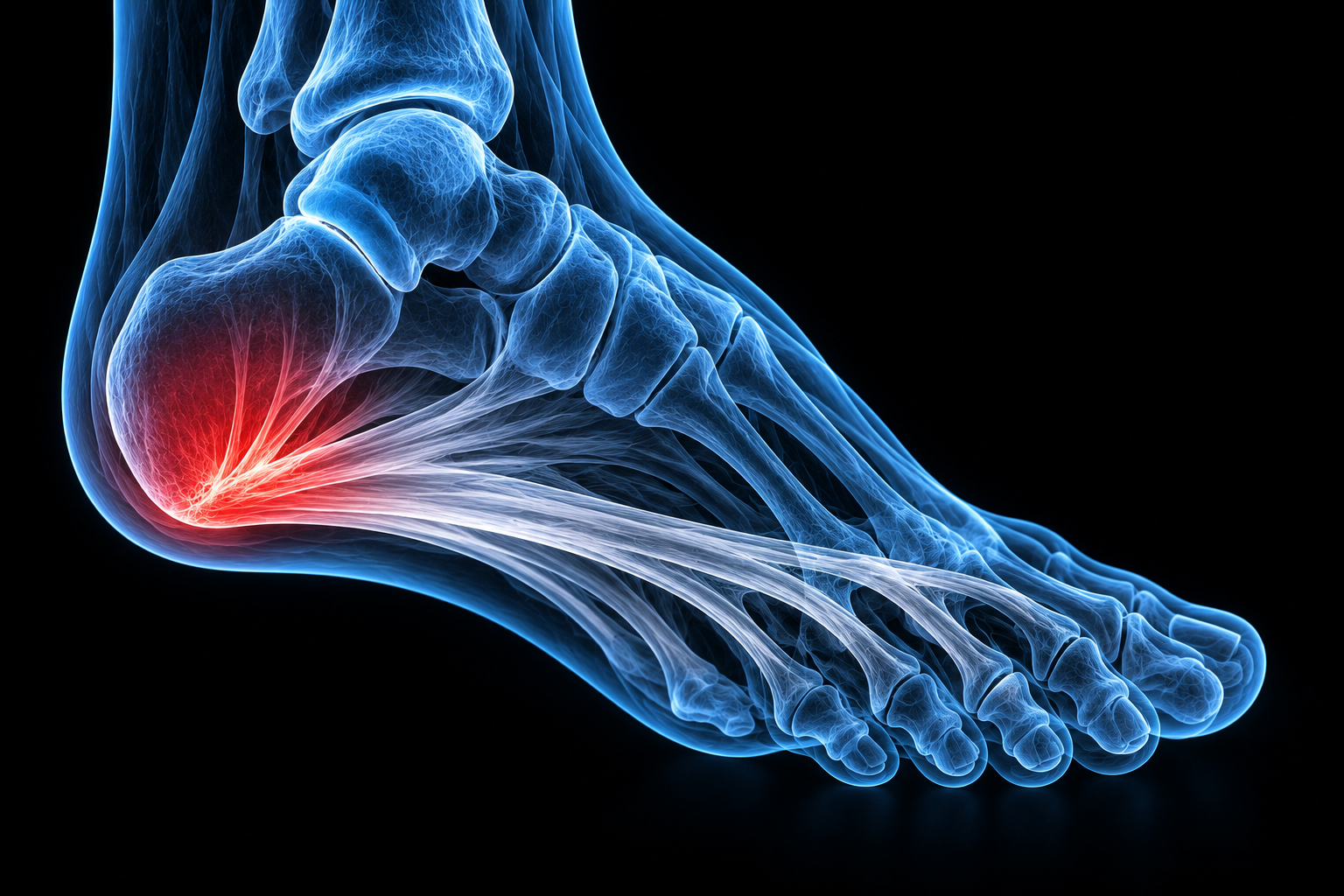
If you've had plantar fasciitis, you know the moment: the first step out of bed in the morning. The heel hits the floor and there's a sharp, stabbing pain — sometimes so intense that the instinct is to immediately sit back down. Then, after a few minutes of walking, the pain eases. By midday, it may barely be noticeable. And then it's back the next morning, in the same spot, with the same intensity.
This pattern — worst first thing in the morning, better with movement, possibly worsening again after prolonged sitting or standing — is the clinical signature of plantar fasciitis. The reason it follows this exact pattern has nothing to do with chance. It's a predictable consequence of what happens to the plantar fascia during the hours when you're not loading it, and what happens to that tissue when you suddenly ask it to bear your full body weight after a night of shortening. Understanding the biology behind the morning pain is both clinically interesting and practically useful — because it changes exactly how you should manage it.
01 | What the Plantar Fascia Is and What It Does
The plantar fascia is a thick band of connective tissue — not a muscle, not a ligament in the traditional sense, but a dense aponeurosis — that runs from the medial tubercle of the calcaneus (the heel bone) to the base of the toes. It's the main structural support of the arch of the foot. When you stand, the fascia tightens through the windlass mechanism: as the toes extend during the push-off phase of gait, the fascia winds around the metatarsal heads and effectively raises and stiffens the arch, creating a rigid lever for propulsion. It does this thousands of times per day.
The plantar fascia is primarily under tensile load. The highest tensile forces through the fascia occur at its proximal insertion — the point where it anchors to the heel bone. This is where the most stress concentrates, and this is where plantar fasciitis almost universally presents: at the medial calcaneal tuberosity, the point on the bottom-inner part of the heel that is exquisitely tender in almost every case.
02 | The Biology Behind the Morning Pain
To understand why morning pain is the cardinal feature of plantar fasciitis, you need to understand what the tissue is doing overnight — and what happens to it in the first moments of loading.
What Happens While You Sleep
During sleep, the foot naturally rests in a position of plantarflexion — the toes pointed slightly downward, the ankle relaxed. In this position, the plantar fascia is at its shortest resting length. The tissue is not under load, blood flow is reduced relative to activity, and the inflammatory metabolic byproducts that accumulated during the previous day begin to settle.
At the site of a plantar fasciitis injury, the overnight period allows the beginning of a repair process — the same process that makes most soft tissue injuries feel temporarily better after rest. Inflammatory cells do their work, the tissue is not being repeatedly loaded, and the sensitized nerve endings in and around the insertion site are not being stimulated.
But there's a consequence: the tissue adapts to its shortened position. The fascia, the calf muscles, and the Achilles tendon all tighten over the course of the night. By morning, the entire posterior chain from heel to toes is in a shortened, tightened state. This is why a night splint — a device that holds the foot in dorsiflexion during sleep — is one of the most evidence-supported treatments for plantar fasciitis. It prevents the overnight shortening that sets up the morning pain cycle.
The First Step: Maximum Load on Minimum Preparation
When you stand for the first step in the morning, two things happen simultaneously: your full body weight lands on the heel, and the fascia is immediately stretched from its fully shortened overnight position to full extension under load. The musculotendinous unit has had no warm-up, no progressive loading, and no fluid distribution within the tissue. The proximal insertion — already damaged, already inflamed — is abruptly pulled to its end range under maximum mechanical load.
This is why the first step hurts more than the hundredth step. The hundredth step occurs after the fascia has been progressively loaded, the calf complex has loosened, and blood flow has redistributed fluid and reduced local tissue stiffness. The tissue is mechanically more accommodating. The first step offers none of these advantages.
03 | This Isn't Inflammation — It's Degeneration
For decades, plantar fasciitis was treated as a primarily inflammatory condition. The name "fasciitis" implies inflammation, and the first-line treatment — rest, ice, NSAIDs — reflects this model. The current understanding from histological studies is significantly different: in chronic plantar fasciitis, the tissue at the proximal insertion shows fasciosis, not fasciitis. The pathological findings are degenerative — disorganized collagen, fibroblast proliferation, and mucoid degeneration — rather than the acute inflammatory cell infiltrate you would expect in a true inflammatory condition.
This distinction matters enormously for treatment. A purely degenerative tendinopathy-type process does not respond to anti-inflammatory management the way an acute inflammatory condition does. This is why many people get temporary relief from cortisone injections but do not resolve long-term — the injection suppresses inflammatory signaling, but the degenerative tissue change at the insertion is not addressed. The evidence now supports loading-based rehabilitation as the primary treatment modality, with anti-inflammatory approaches used as adjuncts rather than the primary strategy.
04 | Risk Factors: Why It Develops in the First Place
- Training load spikes are the most common driver in athletic populations. A sudden increase in running volume, a surface change to concrete or asphalt, the start of a new season, or a return from time off with insufficient ramp-up all increase cumulative load on the fascia faster than tissue adaptation can keep pace.
- Calf and Achilles tightness is the most modifiable biomechanical risk factor. Limited ankle dorsiflexion range of motion — most often caused by a tight gastrocnemius-soleus-Achilles complex — increases the peak tension on the plantar fascia at push-off because the ankle cannot fully absorb the dorsiflexion demand. If the ankle can't dorsiflext, the arch collapses earlier and loads the fascia more aggressively.
- High BMI is the most consistently supported risk factor in non-athletic populations. The plantar fascia is under tensile load proportional to body weight; excess weight directly increases the peak force at the proximal insertion with every step.
- Footwear matters more than it's often given credit for. Worn-down shoes that no longer provide adequate arch support or cushioning, sudden transitions to minimalist footwear without an adaptation period, and working long shifts in unsupportive shoes on hard surfaces all increase plantar fascia load.
05 | What Actually Works: The Evidence-Based Approach
Before You Get Out of Bed
The highest-yield morning routine change for plantar fasciitis is so simple it seems too easy: stretch the plantar fascia and calf before your first step. Sitting on the edge of the bed, dorsiflex the foot, pull the toes back, and hold for 10–30 seconds. This progressively loads the fascia from a shortened position before full weight-bearing is applied — it's the equivalent of a micro-warmup for the tissue. Multiple studies support plantar fascia-specific stretching as the most effective conservative intervention for pain reduction at the proximal insertion.
Eccentric Loading: The Treatment Most People Never Get
Single-leg calf raises — specifically eccentric (lowering) calf raises performed with the heel dropping off a step — are among the most evidence-supported rehabilitation exercises for plantar fasciitis. The rationale parallels that for Achilles tendinopathy: loading the Achilles-calf-plantar fascia chain eccentrically promotes collagen remodeling, improves fascial stiffness in a healthy direction, and builds the load tolerance that prevents recurrence. This is not a passive intervention. It requires consistent loading at the right intensity over 8–12 weeks.
Night Splints
Night splints, which hold the foot in dorsiflexion during sleep, directly prevent the overnight shortening that creates morning pain. They are most effective when morning pain is the dominant symptom pattern. They are uncomfortable for some people, particularly in the first few nights, but compliance is associated with significantly faster morning pain resolution than rehabilitation alone.
Shockwave Therapy
Extracorporeal shockwave therapy (ESWT) has consistently positive evidence for plantar fasciitis, particularly for chronic presentations that have not responded to 3–6 months of conservative management. Multiple network meta-analyses favor ESWT over corticosteroid injection for outcomes beyond one month. It is non-invasive, requires no downtime, and is now widely available in sports physical therapy settings.
- Continuing to run through plantar fasciitis is not always contraindicated — but continuing to run without modifying load, addressing calf tightness, and starting a loading program is the most common path to a chronic 12-month problem. The tissue needs both load reduction and strategic reloading to heal. Stopping completely is not the answer; running less while doing the right rehabilitation is.
- The plantar fascia-specific stretch before your first step in the morning is the simplest high-impact intervention you can start today. It costs 30 seconds and directly addresses the mechanism that produces the most debilitating symptom. If you do nothing else, do this.
- Plantar fasciitis is a load management problem as much as a tissue problem. In athletes, the most common driver is a training spike — too much, too fast, on too little preparation. If the injury developed during a ramp-up period, the ramp was too steep. The tissue adaptation that protects the fascia builds over weeks, not days.
- Spike shoes and hard court surfaces are specific risk factors for athletes. Cleated shoes on hard artificial turf increase peak plantar fascia load. If your symptoms flared after a surface change or footwear change, that's not a coincidence — it's the mechanical explanation.
Heel Pain That Won't Go Away? The Morning Pain Pattern Is Telling You Something.
At KRU Physical Therapy + Performance Lab, we assess and treat plantar fasciitis with loading-based rehabilitation, shockwave therapy, and gait analysis — getting to the mechanical root of the problem rather than managing symptoms. Two locations in South Florida, plus telehealth worldwide.
References
- Rhim HC, et al. A systematic review of systematic reviews on the epidemiology, evaluation, and treatment of plantar fasciitis. Life. 2021;11(12):1287. (Prevalence 15% of foot complaints; 1M+ US physician visits; 17.4% in runners; treatment outcomes evidence.)
- Kneaded Care Physiotherapy. Plantar Fasciitis: Why Your First Steps in the Morning Hurt. 2024. (Morning pain mechanism: overnight shortening, first-step loading, treatment.)
- AOFAS. How to approach Plantar Fasciopathy in Elite Athletes: A Scoping Review of the Literature. 2022. (Athlete-specific evidence; 38.2% rate in competitive runners; treatment options.)
- Pressbooks: Front Line Foot and Ankle. Plantar Fasciitis: Pathophysiology. (Fasciosis vs. fasciitis; degeneration model; windlass mechanism.)
- Michigan Foot Doctors. Why is foot pain worse in the morning? 2023. (Clinical description of morning pain pattern; posterior chain shortening.)