
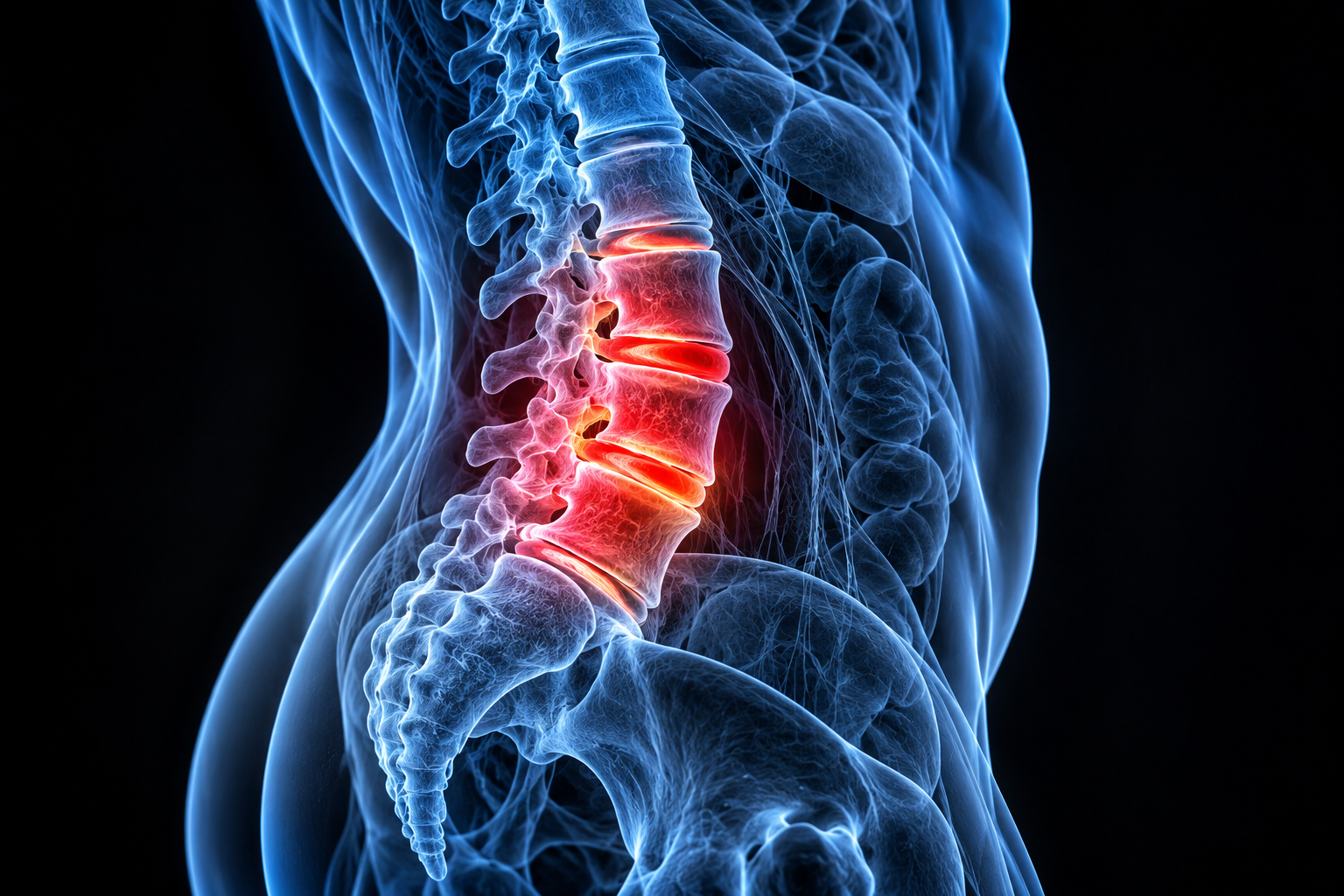
Back pain is one of the most common reasons adults miss work, cut training short, or end up in an urgent care waiting room. Most people have experienced it at some point — that familiar tightness after a long car ride, the sharp pull from picking something up the wrong way, or the dull ache that sets in after sitting at a desk for too many hours in a row.
The instinct is usually one of three things: lie down and wait it out, pull up a YouTube stretching routine, or assume something is seriously wrong and call a doctor. All three responses can be appropriate — depending entirely on what type of back pain you're dealing with. The problem is that most people don't know how to tell the difference, and the wrong response can either delay recovery or, in rare cases, allow something that needed attention to go unaddressed.
This post is a practical guide to the question people ask us most often: what does my back pain actually need?
01 | What Most Back Pain Actually Is
The overwhelming majority of back pain — roughly 85 to 90% of cases — is classified as nonspecific low back pain, meaning it has no identifiable structural cause on imaging. No herniated disc, no fracture, no tumor. The pain is real, often significant, and sometimes very limiting. But it originates from a combination of muscle strain, joint irritation, movement pattern dysfunction, and load tolerance issues rather than from damage to a specific structure.
This matters for two reasons. First, it means that imaging — an X-ray or MRI — is usually not necessary or helpful in the early stages of back pain, and getting one rarely changes the management. Second, it means that the things most likely to help are movement-based: staying active, addressing what's driving the load through the spine, and improving the capacity of the structures involved. Not bed rest. Not immobility. Not waiting.
Acute vs. Subacute vs. Chronic
Back pain is also categorized by duration, which affects both the expected trajectory and the appropriate response:
- Acute: Less than 6 weeks. Most acute back pain resolves on its own with activity modification and appropriate movement. This is the window where rest is most tempting — and most counterproductive if overdone.
- Subacute: 6–12 weeks. Pain that hasn't resolved in the acute phase. At this point, the trajectory matters: if it's improving, continue with active management. If it's plateauing or worsening, this is the window to get professional input before it becomes chronic.
- Chronic: More than 12 weeks. Chronic back pain is a different clinical picture that typically involves central sensitization, fear-avoidance behavior, and often requires a more structured, progressive rehabilitation approach. Self-managing chronic back pain with rest or generic stretching rarely works and frequently makes things worse over time.
02 | The Case Against Bed Rest
Bed rest for back pain was the standard recommendation for decades. It is no longer. A Cochrane review pooling 10 randomized trials — 1,923 participants with acute low back pain — found that advice to stay active produces small but meaningful improvements in pain and function compared to advice to rest in bed. The difference isn't enormous, but the direction is clear and consistent: movement helps, immobility doesn't.
The reasoning is straightforward. Spinal discs, facet joints, and the surrounding soft tissue all depend on movement and load for nutrition, hydration, and healing. Prolonged inactivity leads to muscle deconditioning, stiffness, and increased fear-avoidance — the behavioral pattern in which pain leads to reduced activity, which reduces capacity, which makes pain more likely on the next load exposure. Fear-avoidance behavior is one of the strongest predictors of back pain becoming chronic, and it is reinforced by telling someone to rest until they feel better.
03 | When Stretching Helps — and When It Doesn't
Stretching is the most common self-treatment for back pain, and it can be appropriate — depending on what is driving the pain and which movements are being loaded.
When Stretching Is Useful
For pain that is primarily driven by muscle tightness, postural dysfunction, or movement restriction, stretching that addresses the relevant tissues can reduce symptoms and improve range of motion. Hip flexor stretches, piriformis stretching, and lumbar mobility work are all commonly helpful for the desk-sitting athlete or the person whose back stiffens after long periods of inactivity. If movement in a particular direction reliably reduces your pain, more of that movement is generally appropriate in the early stages.
When Stretching Is Not the Answer
Stretching has real limitations that most YouTube routines don't acknowledge:
- Stretching is not strengthening. The majority of chronic and recurrent back pain is driven by deficits in load tolerance — the capacity of the lumbar spine, glutes, hamstrings, and core to handle the demands placed on them. A tight hamstring is often a symptom of an eccentric load deficit, not a flexibility problem. Stretching the muscle without building its capacity rarely resolves the underlying issue.
- Direction matters. Some back pain presentations — particularly disc-related pain — respond better to extension movements (back bends) than flexion (forward bends). For others, the reverse is true. A generic stretching routine that loads your spine in the wrong direction can temporarily worsen symptoms or reinforce a movement pattern that's already contributing to the problem.
- Pain that worsens with stretching is a signal. If a stretch consistently reproduces or increases your pain, don't push through it. It may mean you're loading the wrong structure, in the wrong direction, at the wrong stage of healing. This is exactly the kind of clinical picture that benefits from professional assessment rather than self-directed management.
04 | The Red Flags That Mean See Someone Now
The vast majority of back pain does not involve serious pathology. But a small percentage — less than 1% in primary care populations — does involve something that requires immediate medical evaluation: spinal infection, vertebral fracture, cancer affecting the spine, or cauda equina syndrome. These presentations require imaging and often urgent intervention. Knowing the red flags is essential even if you rarely encounter them.
- Bladder or bowel dysfunction — inability to urinate, loss of bowel control, or numbness in the groin or inner thighs (saddle area). This pattern suggests cauda equina syndrome, a surgical emergency.
- Significant leg weakness — not just pain radiating down the leg, but actual weakness or difficulty lifting the foot (foot drop).
- Pain that is constant, severe, and worsening at night — especially if it doesn't change with position. Back pain that relieves with certain movements is typically mechanical. Pain that is position-independent and worsens at rest warrants investigation.
- Unexplained weight loss with back pain — particularly in older adults or those with a history of cancer.
- Fever or signs of infection combined with back pain, especially after a recent procedure, injection, or infection elsewhere in the body.
- Back pain following significant trauma — a fall from height, a motor vehicle accident, or any high-force impact — particularly in older adults with potential for vertebral fracture.
None of these presentations are appropriate for self-management or a wait-and-see approach. If any of these apply, skip the stretching routine and go directly to a physician or emergency department.
05 | When Physical Therapy Is the Right Call
Outside of the red flags above, there is a large middle category of back pain that doesn't need an ER but also doesn't respond well to self-managed rest and stretching. This is where physical therapy produces its best outcomes — and where timing matters more than most people realize.
What the Data Says About Early PT
A large study of 122,723 patients with new low back pain found that those who started physical therapy within 14 days of a physician visit had 60% lower back pain-related costs over the following two years, and significantly lower rates of opioid use, lumbar spinal injections, advanced imaging, and surgery compared to patients who waited. Early intervention doesn't just improve outcomes — it changes the trajectory of care.
The clinical reason is straightforward: when physical therapy begins early, it can interrupt the fear-avoidance cycle before it becomes established, address the load tolerance deficits that are driving the pain while the window for easy intervention is still open, and provide a movement-based framework before the person has developed compensatory patterns that need to be unloaded and rebuilt.
Signs That Your Back Pain Needs Professional Assessment
- Mild ache after an unusual activity or prolonged sitting
- Stiffness that improves within an hour of waking and with movement
- Pain that is clearly activity-related and settles with short rest
- No leg symptoms, no weakness, no red flags above
- Improving over the first 3–5 days with normal activity
- Pain that hasn't meaningfully improved after 1–2 weeks of active management
- Pain radiating into the glute, hip, or down the leg (but no red flags above)
- Recurrent back pain — the same issue returning every few months or seasons
- Pain that is limiting specific movements, positions, or activities
- Pain that changes with different positions or movements but you can't figure out the pattern
- Back pain in an athlete preparing for or returning to a sport
- Any subacute (6–12 week) back pain that has plateaued or is not improving
- Any of the red flags listed in Section 04
- Significant neurological symptoms: leg weakness, foot drop, bilateral leg symptoms
- Pain following significant trauma
- Bowel or bladder changes of any kind
- Saddle area numbness or tingling
06 | What a Physical Therapist Does for Back Pain
One of the reasons people delay PT for back pain is that they don't know what to expect. The assumption is often that PT means heat packs, massage, and the same set of core exercises everyone gets. In a performance-based clinical environment, it's a different process.
- Movement assessment: Which positions and movements reproduce or relieve pain, and what that pattern tells us about the likely driver — disc, facet, muscle, or neural involvement. This directs early management in a way that generic stretching cannot.
- Load tolerance testing: Identifying the strength and capacity deficits in the surrounding structures — hip extensors, deep core, thoracic mobility — that are forcing the lumbar spine to absorb load it shouldn't be absorbing alone.
- Progressive loading: Not rest, and not just stretching. A structured program that builds capacity in the tissues and movement patterns that are creating vulnerability, progressed in a way that stays within a manageable pain window.
- Return to sport or activity: For athletes, bridging the gap between symptom resolution and the specific demands of training — because pain-free on a Tuesday doesn't mean ready for Friday's practice.
The goal of physical therapy for back pain is not to eliminate pain in the short term and send you home. It's to find what's driving the pain, build capacity in the things that are underperforming, and develop enough understanding of your own movement that the next flare-up is shorter, less severe, and easier to manage.
Not Sure What Your Back Pain Needs?
At KRU Physical Therapy + Performance Lab, we assess back pain across the full clinical picture — from acute flare-ups to chronic recurrence to return-to-sport timelines for athletes. If your back pain hasn't resolved on its own or keeps coming back, a movement-based assessment is the fastest way to understand why. Two locations across South Florida, plus telehealth worldwide.
References
- Dahm KT, et al. Advice to rest in bed versus advice to stay active for acute low-back pain and sciatica. Cochrane Database Syst Rev. 2010;2022 update. (10 RCTs, n=1,923; staying active produces small improvements in pain and function vs. bed rest for acute LBP.)
- Childs JD, et al. Early physical therapy reduces healthcare utilization and costs in patients with low back pain. BMC Health Services Research. 2015. (n=122,723; early PT within 14 days associated with 60% lower LBP-related costs at 2 years.)
- Henschke N, et al. Red flags presented in current low back pain guidelines: a review. Eur Spine J. 2016. (Prevalence of serious pathology in primary care LBP populations; red flag reliability and prevalence.)
- Waddell G, et al. Systematic reviews of bed rest and advice to stay active for acute low back pain. Br J Gen Pract. 1997;47(423):647–652. (Foundation evidence against bed rest; advice to stay active.)
- O'Sullivan P. Diagnosis and classification of chronic low back pain disorders. Man Ther. 2005. (Nonspecific LBP classification, fear-avoidance behavior, and central sensitization in chronic LBP.)
- GBD 2021 Low Back Pain Collaborators. Global, regional, and national burden of low back pain. Lancet Rheumatol. 2023. (Low back pain leading cause of disability; lifetime prevalence statistics.)