
Sprinting Isn't Cutting: How to Train for Linear Speed vs. Change of Direction
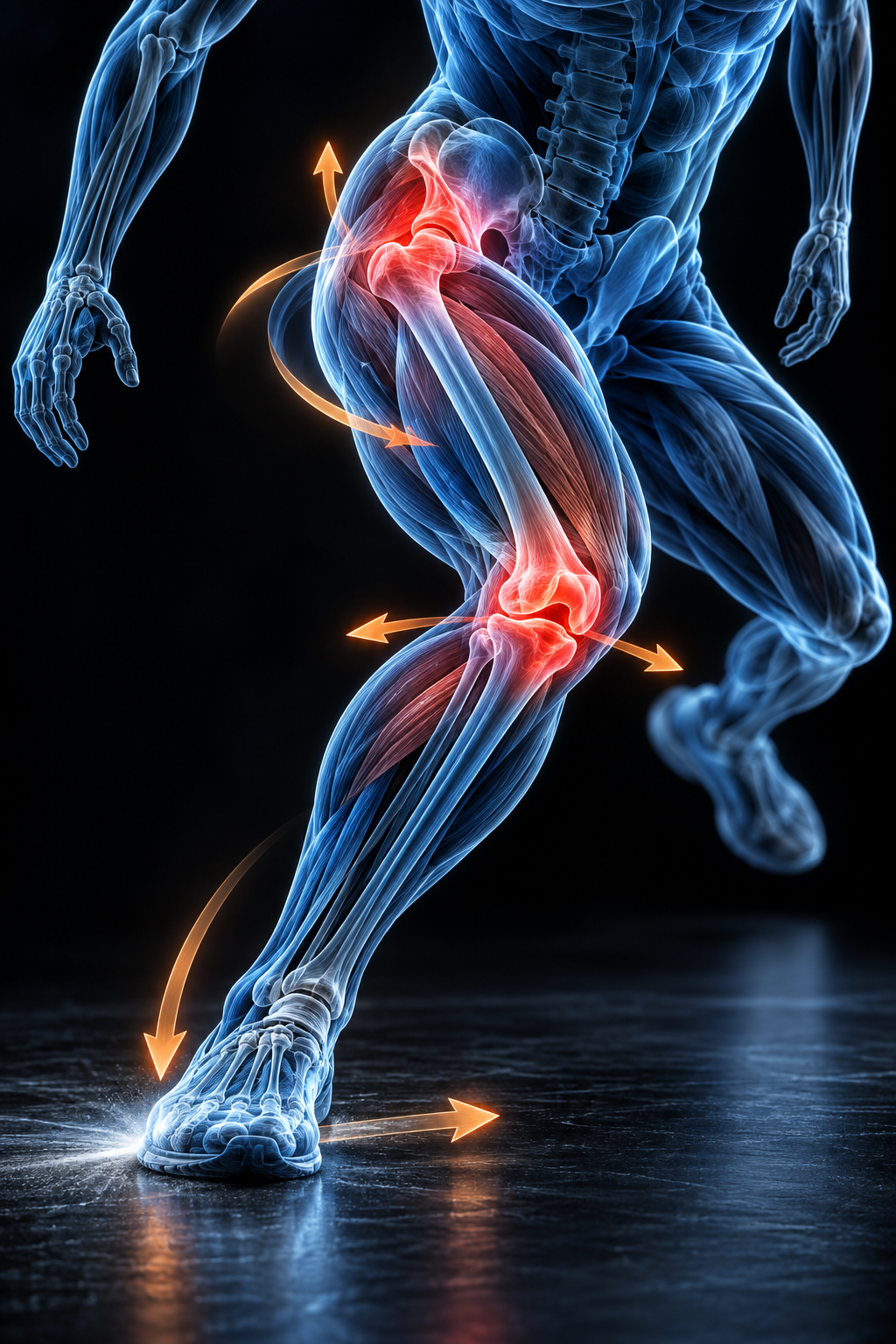
Most speed training programs are built around one thing: running in a straight line. Sprints, resisted sprints, tempo runs, flying 10s — all of it measured in one direction. That training is valuable, and the research supports it. But for athletes in football, basketball, soccer, lacrosse, volleyball, and nearly every other team sport, the straight line is a small fraction of what the game actually demands.
The ability to change direction — to decelerate, reorient, and reaccelerate in a new direction at game speed — is one of the most physically demanding and injury-relevant skills in multidirectional sport. And the research is increasingly clear that it doesn't develop automatically from sprint training. It requires its own stimulus, its own biomechanical demands, and its own progressions. An athlete who sprints fast in a straight line and an athlete who changes direction efficiently have trained different systems — and assuming one transfers to the other is one of the most consistent gaps in how athletes and coaches build speed programs.
At KRU Physical Therapy + Performance Lab, we work with athletes preparing for seasons, returning from injury, and trying to close the gap between their gym performance and their on-field results. The distinction between linear speed and change-of-direction ability is central to both injury prevention and performance development.
01 | Why Sprinting and Cutting Are Different Skills
At the surface level, sprinting and changing direction look like they share the same physical foundation — power, leg drive, coordination. They do share some qualities. But the biomechanical demands diverge in ways that matter for both performance and injury risk.
Linear Sprint Mechanics
Linear sprinting is about maximizing horizontal velocity in one direction. The primary demands are concentric and elastic force production — the ability to generate large ground reaction forces during foot contact and transfer them efficiently into forward propulsion. Stride length, stride frequency, ground contact time, and the horizontal force-velocity profile are the key determinants of sprint performance. The body is moving in the sagittal plane, and the neuromuscular system is primarily generating force concentrically and through the stretch-shortening cycle to maintain and increase speed.
Change of Direction Mechanics
Change of direction requires something fundamentally different: the ability to decelerate momentum in one direction, absorb and redirect ground reaction forces, and reaccelerate in a new direction — often under time pressure and unpredictable conditions. A 2025 systematic review in Sports Medicine identified the primary biomechanical determinants of COD performance as shorter ground contact time, higher approach and exit velocities, greater braking and propulsive forces, forward trunk inclination, lower center-of-mass height, and increased hip, knee, and ankle power during the directional change.
The critical difference is the eccentric and braking demands. During COD, the knee extensors act eccentrically to absorb momentum and enable the rapid transition to reacceleration. This is a fundamentally different neuromuscular demand than the concentric force production that drives sprinting — and it requires specific training to develop. It doesn't transfer automatically from straight-line speed work.
02 | The Injury Angle — Why Linear Sprint Training Alone Can Increase ACL Risk
The most striking finding on this topic goes beyond performance and into injury prevention — and it's one coaches and athletes need to understand before defaulting to sprint training as their primary speed development tool.
The 2024 COD Injury Study
A 2024 study published in Scientific Reports compared two 8-week injury prevention programs in multidirectional team sport athletes: one that combined general injury prevention exercises with COD-specific technique training, and one that substituted linear sprint training for the COD component. Both groups performed the same general injury prevention program. The difference was what they added to it.
The results were clinically significant. The COD-specific training group showed significant reductions in peak knee abduction moments, initial knee abduction angles, and lateral trunk lean during a 135° COD task — all biomechanical variables directly associated with ACL injury risk. The linear sprint training group, by contrast, showed a large increase in lateral trunk lean and non-significant increases in both knee abduction angle and peak knee abduction moment. The researchers described this as "a more ACL injury-prone movement pattern." Their conclusion was direct: linear sprint training in multidirectional team sports should be combined or alternated with COD technique training to limit knee joint loads during high-speed change-of-direction movements.
Why This Happens Mechanically
The finding makes biomechanical sense when you consider what linear sprint training optimizes. Sprint mechanics favor a more upright trunk, aggressive forward lean, and maximal horizontal force production — qualities that are counterproductive during a sharp COD, where forward trunk inclination toward the new direction, lower center-of-mass, and knee flexion at contact are protective. An athlete whose movement patterns have been reinforced by high volumes of linear sprint training may be developing mechanics that carry higher knee load risk specifically during the COD situations they encounter most in competition.
03 | The COD Angle Problem: Not All Cuts Are Equal
One of the more practically important findings in recent COD biomechanics research is that the angle of the directional change significantly affects both the performance demands and the injury risk profile. A 2025 study examining 45°, 90°, 135°, and 180° COD tasks found meaningfully different knee joint loads across angles — with direct implications for how training should be structured.
| COD Angle | Performance Demand | Knee Joint Load | Primary Training Priority |
|---|---|---|---|
| 45° | High speed through contact; approach velocity is the primary determinant | Lower — more similar to linear sprint mechanics | Approach speed, hip power, short ground contact time |
| 90° | Balanced braking and propulsion; significant hip and knee power required at contact | Moderate — eccentric knee demands increase | Eccentric strength, penultimate step mechanics, trunk position |
| 135° | High braking demand; deceleration quality is the primary determinant | High — peak knee abduction moments increase substantially | Deceleration mechanics, knee flexion at contact, frontal plane hip control |
| 180° | Near-complete reversal of momentum; multi-step deceleration required | Highest — sustained eccentric loading across multiple contacts | Eccentric strength capacity, multi-step deceleration, neuromuscular control |
The practical implication: training programs should include angle-specific COD work — not just generic agility drills. An athlete who only trains 45° cuts will be underprepared for the braking demands of a 135° cut, which is the angle most associated with non-contact ACL injuries. Position-specific COD training that reflects the angles and frequencies encountered in competition produces more relevant adaptations than generic multidirectional work.
04 | What Each Quality Requires in Training
Linear speed and COD ability share some physical foundations — lower-body strength, power, ground contact efficiency — but the specific training stimuli that develop each quality are different enough to warrant separate programming attention.
Training for Linear Speed
- Resisted sprint training — Sled pushes at 10–20% body mass have the strongest evidence for improving horizontal force production and acceleration. A 2025 meta-analysis found resisted sprint training produced significantly greater improvements in COD ability than unresisted sprinting (SMD 1.10 vs. 0.60) — likely through improved horizontal force production that also transfers to the braking and propulsive phases of COD.
- Maximum velocity work — Flying sprints and build-up runs that challenge top-end speed specifically, since acceleration training doesn't fully develop maximum velocity mechanics.
- Bilateral strength and power — Squats, hip thrusts, and plyometrics that develop the concentric and elastic force production capacity that drives sprint mechanics.
Training for Change of Direction
- COD-specific technique training — Structured drills that target three key technical elements: decelerating at the penultimate foot with appropriate knee flexion, dropping the center of mass, and driving horizontally into the new direction at foot contact. These mechanics don't develop automatically from speed work — they require deliberate practice with feedback.
- Eccentric strength training — Nordic hamstring exercise, single-leg Romanian deadlifts, and flywheel training that build the muscle's capacity to absorb force during the braking phase. Research on COD performance has consistently identified eccentric strength as one of the most important physical qualities for both COD speed and injury risk reduction.
- Unilateral plyometrics and strength — A 2026 meta-analysis found unilateral training produced superior COD improvements compared to bilateral training, consistent with the single-leg loading that COD demands. Lateral bounds, single-leg step-ups, and split-stance jumps develop the asymmetric force absorption and production patterns COD requires.
- Angle-specific drills — Progressive exposure to 45°, 90°, 135°, and 180° COD tasks with technique feedback, so the neuromuscular system develops movement patterns that are both fast and mechanically safe across the full range of cut angles the sport demands.
05 | Putting This Into Practice
- Audit your current training for the ratio of linear to COD work. If your speed sessions are primarily straight-line sprints, you're developing one quality while leaving the other systematically undertrained — and, based on the 2024 research, potentially developing movement patterns that increase your knee load risk during cuts.
- Include eccentric strength training year-round as a foundation for COD ability. The braking phase of a COD is an eccentric demand, and the muscles that control it — particularly the hamstrings, glute medius, and quad — need to be specifically loaded eccentrically to build the capacity the sport requires.
- Practice COD mechanics deliberately, not just COD speed. Approach velocity, penultimate step position, knee flexion at contact, and trunk lean toward the new direction are all technical variables that respond to cued practice with feedback — the same way sprint mechanics do.
- Train cut angles that reflect your sport and position. A wide receiver cutting at 45° needs different training emphasis than a soccer midfielder executing 135° turns under pressure.
- Build COD-specific training into your speed development program as a separate category — not a byproduct of sprint training. The evidence is consistent that COD ability requires its own stimulus, and linear sprint training transfers partially at best.
- Incorporate angle-specific COD drills that reflect your sport's movement demands. Generic agility ladder work develops coordination but doesn't create the high-speed deceleration and reacceleration demands that improve real COD performance or reduce injury risk at game speeds.
- Treat deceleration as a skill that requires coaching, not just a physical capacity. The technical elements of COD — penultimate step mechanics, center-of-mass management, trunk position — are coachable and improve with structured feedback, as the 2024 COD technique training research demonstrates.
- Be aware that linear sprint training alone can increase ACL injury-prone movement patterns during COD. Combining or alternating linear and COD training — rather than substituting one for the other — is the approach the research supports for both performance development and injury risk management.
Sprinting fast in a straight line and changing direction efficiently are related but distinct athletic qualities that develop through different training stimuli, make different demands on the neuromuscular system, and carry different injury risk profiles. The athletes who perform best in multidirectional sport — and stay healthiest doing it — are the ones whose training programs address both. Not one instead of the other.
Looking to Build Speed and Change-of-Direction Ability That Transfers to Your Sport?
At KRU Physical Therapy + Performance Lab, we assess linear speed mechanics, COD movement quality, and the strength deficits that limit both — and build progressive programs that develop each quality specifically. Two locations across South Florida, plus telehealth worldwide.
References
- Mohr M, et al. An 8-week injury prevention exercise program combined with change-of-direction technique training limits movement patterns associated with anterior cruciate ligament injury risk. Sci Rep. 2024;14:3152.
- Biomechanical Determinants of Change of Direction Performance: A Systematic Review. Sports Med. 2025;55:2207–2224.
- Biomechanical effects of different change of direction angles on lower limb joint load and injury risk in soccer players. Sci Rep. 2025.
- Solleiro-Duran D, et al. Effects of linear versus curvilinear sprint training on multidirectional speed in young soccer players. Biol Sport. 2025.
- Effects of resisted sprint training on sprint, jump, and change-of-direction performance: a systematic review and meta-analysis. Front Physiol. 2025.
- Effect of change-of-direction vs. linear repeated sprint training on physical performance in female college basketball players. PMC. 2025.
- Comparative Effects of Repeated Linear Sprint and Change-of-Direction Speed Training on Performance in Youth Soccer Players. PMC. 2025.
- Effects of unilateral versus bilateral training on linear sprint and change-of-direction performance: a systematic review and meta-analysis. Front Physiol. 2026.
- Clinical Utility of Qualitative Change of Direction Movement Assessment in ACL Injury Risk Evaluation. IJSPT. 2025.
- Biomechanical Effects of a 6-Week COD Speed and Technique Modification Intervention. J Strength Cond Res. 2020.