
Managing Shin Splints: Moving Beyond Rest-Only Approaches
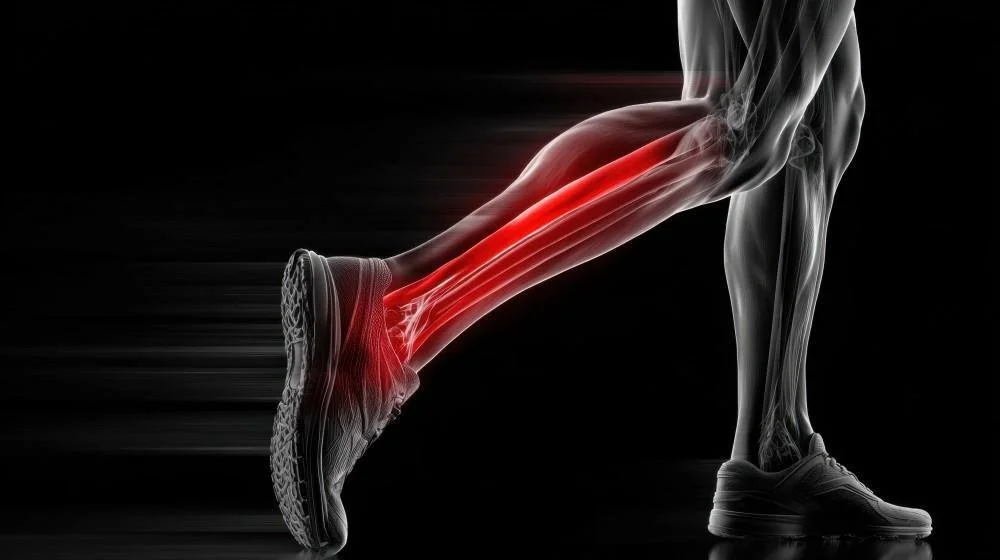
Shin splints affect up to 35% of runners and military recruits each year — and rest alone does not fix the underlying problem. Here is what the evidence says about why they happen and how to actually resolve them.
What Are Shin Splints, Really?
"Shin splints" is a catch-all term most people use to describe pain along the inner edge of the shinbone. The clinical name is medial tibial stress syndrome (MTSS). It refers to bone stress and inflammation of the connective tissue that attaches to the tibia (shinbone).
MTSS is not a muscle cramp. It is not simply soreness. It is a load-tolerance problem — meaning the tibia and surrounding tissue are absorbing more stress than they are currently conditioned to handle.
This distinction matters because it directly changes how you treat it.
Why Rest Alone Is Not Enough
Rest reduces pain. That part is true. But rest does not build the bone density, calf strength, or tissue tolerance needed to handle running loads when you return.
Research published in the British Journal of Sports Medicine found that return-to-sport rates after MTSS using rest-only protocols were low and recurrence rates were high — often over 70% in the first season back.
Here is the core problem with rest-only: you return to the same activity, with the same tissue capacity, on the same training schedule that caused the injury. Nothing has changed except time.
Effective MTSS management requires progressive loading — a deliberate, structured process of reintroducing stress to the tibia and surrounding tissue so it adapts and becomes more resilient.
The Physiology: What Is Actually Happening in the Bone
Your tibia is not a static structure. It responds to mechanical loading by remodeling — breaking down old bone and building new, stronger bone.
When training load increases faster than the bone can remodel, you get a net deficit. Bone breakdown outpaces bone formation. This creates micro-stress at the tibial cortex (the outer layer of the bone) and triggers an inflammatory response in the periosteum — the thin tissue layer wrapping the bone.
That is what you feel as shin pain.
The good news: bone responds well to controlled, progressive loading. Studies using tibial bone scans show measurable increases in bone density when training is managed correctly over 8–12 weeks.
The bad news: it takes time. The bone's remodeling cycle does not speed up just because you want to return faster.
Who Gets Shin Splints and Why
MTSS does not happen randomly. There are clear, identifiable risk factors:
Training-related:
Sudden increases in weekly mileage (more than 10% per week is a commonly cited threshold)
Transitioning to harder surfaces (grass to concrete, trail to track)
Inadequate recovery time between sessions
Low bone density from underfueling or low energy availability
Biomechanical:
Excessive foot pronation (inward rolling) during the loading phase of gait
Increased tibial internal rotation
Weak hip abductors and external rotators — which leads to poor control of lower leg mechanics
Cadence that is too low, creating longer ground contact time and higher impact per step
Individual factors:
Female athletes, particularly those with a history of low caloric intake or irregular menstrual cycles, show higher rates of MTSS — related to lower bone density
Previous history of MTSS is the single strongest predictor of recurrence
The 4-Phase Approach to Managing MTSS
There is no shortcut to resolving shin splints. But there is a clear process. Here is a framework used in clinical practice.
Phase 1: Reduce the Acute Load (Days 1–10)
The goal in this phase is pain reduction — not elimination of all activity.
Reduce or temporarily stop running
Switch to low-impact cardio: pool running, cycling, or elliptical to maintain fitness without tibial stress
Begin calf raises (seated and standing) — the soleus and gastrocnemius are the primary muscles that absorb tibial force
Apply ice for 10–15 minutes after activity if pain is present
Avoid complete immobilization unless a stress fracture has been ruled out by imaging
Clinical note: If pain is sharp, localized to a single spot, present at rest, or wakes you at night — get imaging. These are red flags for a tibial stress fracture, which requires a different management protocol.
Phase 2: Load the Tissue Progressively (Weeks 2–5)
This is the most important phase — and the one most people skip.
The bone and connective tissue need controlled stress to adapt. Exercises that directly load the tibia include:
Single-leg calf raises (3 sets of 15–20 reps, progressing to weighted)
Tibialis posterior strengthening (resisted inversion with a band)
Hip strengthening — side-lying clams, resistance band walks, single-leg deadlifts
Hopping and jump progressions — started at low intensity once pain-free walking is confirmed
Hip strengthening is not optional. Weak glutes and hip abductors increase tibial stress by allowing the femur to drop inward, which rotates the tibia and changes how force is distributed through the bone.
Progress is guided by pain. A pain rating of 0–2 out of 10 during and after exercise is acceptable. Pain above 4 out of 10 means the load is too high.
Phase 3: Return to Running — Graduated (Weeks 4–8)
Return to running is not a single moment. It is a process.
A standard return-to-run progression looks like:
WeekSession StructureWeek 1Walk 1 min / Run 1 min × 10 (pain ≤ 2/10)Week 2Walk 1 min / Run 2 min × 8Week 3Walk 1 min / Run 3 min × 6Week 4Continuous 20-minute run at easy paceWeeks 5–6Build to 80% of pre-injury volume
No skipping steps. Pain during or after a session means you repeat that week's load, not advance.
Cadence adjustment: Increasing running cadence by 5–10% (steps per minute) reduces tibial stress by shortening stride length and decreasing impact forces. A simple metronome app can guide this change.
Phase 4: Return to Full Training and Injury Prevention (Weeks 8–12+)
Full return to training requires more than pain-free running. It requires that the tissue can handle the full demand of the sport.
Before clearing for full activity:
Single-leg calf raise max: 25+ repetitions without fatigue or pain
No pain during or 24 hours after a 30-minute run
Symmetric strength in hip abduction and external rotation (compared to uninjured side)
Running volume is back to pre-injury baseline without symptom recurrence
Ongoing maintenance — 2 days per week of calf and hip strengthening — significantly reduces re-injury risk.
Footwear and Orthotics: What the Evidence Says
Footwear is a common question. The honest answer: there is no single shoe type proven to prevent MTSS. However:
Worn-out running shoes (over 300–500 miles) lose midsole cushioning and should be replaced
Shoes that support the arch may reduce tibial stress in athletes with excessive pronation
Custom orthotics show modest evidence for MTSS prevention in high-risk populations (military recruits, high-mileage runners)
The impact of footwear is secondary to load management and strength. No shoe compensates for a 30% spike in weekly mileage.
Nutrition and Bone Health
This part is often overlooked and clinically significant.
Bone density is directly tied to caloric intake, calcium, and vitamin D levels. Athletes who are chronically underfueling — particularly female athletes — have measurably lower tibial bone density and significantly higher rates of MTSS and stress fracture.
If MTSS is recurring despite appropriate load management and strengthening, a nutrition and bone health screening is warranted. This includes:
Total caloric intake relative to training load
Calcium: 1,000–1,300 mg per day recommended for active adults
Vitamin D: blood levels below 30 ng/mL are associated with increased bone stress injury risk
Menstrual cycle regularity in female athletes (irregularity is a red flag for low energy availability)
What to Do If Symptoms Are Not Improving
If pain has not meaningfully improved after 4–6 weeks of structured loading and modified activity, further evaluation is appropriate.
Imaging options:
MRI is the most sensitive tool for grading tibial bone stress and ruling out a stress fracture
X-rays are typically negative in early MTSS and are not the best first-line tool
Bone scans (SPECT-CT) can also quantify tibial stress response
Grade matters: A tibial stress reaction (bone edema without fracture line) and a tibial stress fracture require different timelines and restrictions. This distinction can only be made with imaging.
Key Takeaways
Shin splints are a load-tolerance problem, not a rest problem. The tibia and surrounding tissue are failing to keep up with training demand — and the solution is building that capacity back up in a structured way.
The core principles:
Rule out stress fracture before beginning progressive loading
Reduce but do not eliminate load in the early phase
Prioritize calf and hip strengthening — these are not optional extras
Return to running gradually with clear pain guidelines
Address nutrition if symptoms keep recurring
Expect 8–12 weeks for full resolution in moderate cases
Rest has a role in early symptom control. But long-term resolution comes from progressive loading, strength work, and smart training management — not time off alone.