
Managing Hip Impingement: It's Not Just About Hip Mobility
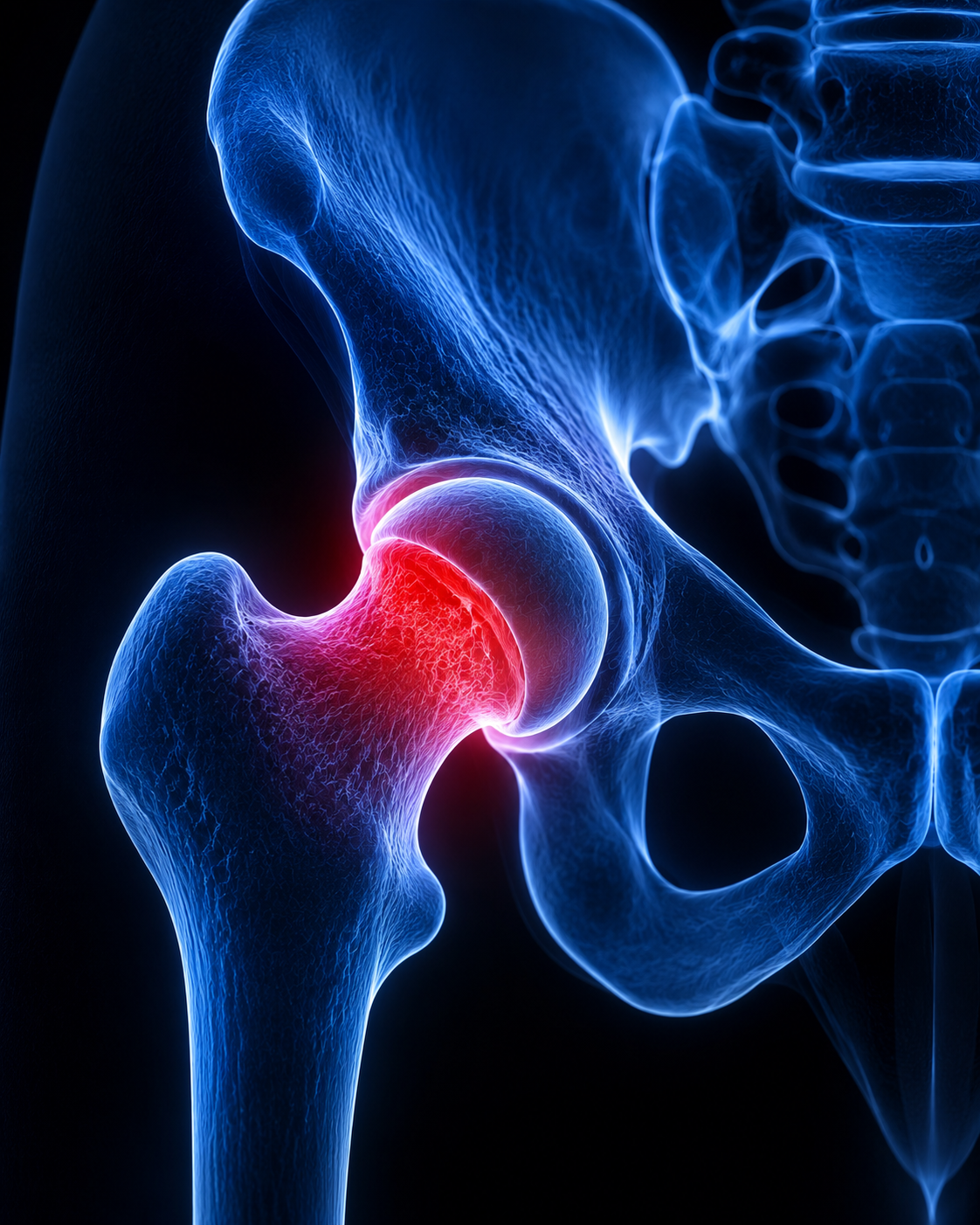
Hip pain in athletes is almost always blamed on tightness. The fix, most assume, is to stretch more. Research tells a different story — athletes with symptomatic femoroacetabular impingement (FAI) consistently show measurable strength deficits compared to healthy peers, and those deficits, not lack of flexibility, are often the bigger driver of ongoing symptoms.
FAI occurs when the ball and socket of the hip come into contact earlier than they should during certain movements. This can create pain in the front of the hip, reduce motion, and make activities like squatting, sprinting, cutting, and prolonged sitting uncomfortable. The instinct to stretch through it is understandable — but in many cases it makes things worse, not better.
At KRU Physical Therapy + Performance Lab, we work with athletes managing hip impingement across a wide range of sports. What we see consistently is that the athletes who improve aren't the ones who stretched the most — they're the ones who rebuilt strength, retrained movement patterns, and managed their workload intelligently around the anatomy they have.
01 | Why "Just Stretch More" Falls Short
Many athletes assume the solution to hip impingement is to stretch more. The problem is that the shape of the hip joint places a limit on how much mobility can be gained through stretching alone. FAI is fundamentally a structural issue — the femoral head-neck junction or the socket itself has a shape that brings bone into contact with bone earlier than it would in a typical hip. No amount of stretching changes that underlying anatomy.
In many cases, repeatedly forcing the hip into painful positions simply increases irritation without improving long-term function. Chasing a few extra degrees of motion that the joint's structure may not actually allow can do more harm than good, aggravating the very tissue — the labrum and joint capsule — that's already under stress from the impingement itself.
02 | What's Actually Contributing to Symptoms
Several factors commonly contribute to ongoing symptoms. As with most overuse and joint-mechanics issues, they tend to compound each other rather than act independently.
Hip Strength Deficits Are Common
Research has found that athletes with symptomatic hip impingement often demonstrate weakness in the hip extensors, flexors, and surrounding stabilizing muscles. One case-control study comparing FAI patients to both healthy non-athletes and matched athletes found hip muscle strength deficits of 16–19% compared to healthy controls, and 24–30% compared to athletes at a similar activity level. When these muscles cannot effectively control movement, stress on the hip joint increases — the same joint that's already structurally predisposed to impingement ends up with less muscular support to manage the load.
Pelvic and Trunk Control Influence Hip Mechanics
The hip does not function in isolation. Poor control of the trunk and pelvis can change joint positioning during squatting, running, jumping, and cutting. This can place the hip into positions where impingement occurs more frequently — for example, excessive anterior pelvic tilt or poor trunk stability during a cut can drive the femur further into the socket at exactly the angle where bony contact happens earliest.
More Mobility Is Not Always Better
Many athletes spend significant time chasing range of motion they may never achieve because of their underlying hip anatomy. Improving movement quality within available range is often more valuable than forcing additional motion. Functional performance research comparing athletes with symptomatic FAI to healthy controls has found measurable deficits not just in hip range of motion, but in sprint speed, agility, squat depth, and single-leg jump performance — suggesting the issue isn't simply "not enough motion," but how effectively the available motion is being used under athletic demand.
Load Management Matters
Symptoms often increase when training volume, running mileage, lifting intensity, or sport participation rises faster than the hip can tolerate. Managing workload can be just as important as exercise selection. FAI is also more common in athletes than in the general population — high-impact, repetitive hip flexion and rotation sports like soccer, hockey, and martial arts have all been associated with a higher prevalence of FAI anatomy, likely because repetitive loading during skeletal development shapes how the joint forms in the first place.
03 | Rethinking the Goal
A common misconception is that painful hips simply need more stretching. In reality, many athletes benefit more from improving hip strength, trunk stability, force absorption, and movement efficiency. Stronger glutes, better pelvic control, and improved lower-body mechanics can help distribute stress more effectively throughout the kinetic chain.
The goal is not to create unlimited hip mobility. The goal is to improve how the available mobility is used during sport and daily activity. An athlete who moves efficiently and with good control through a slightly restricted range often does better long-term than one who has more raw motion but poor control over it.
04 | Putting This Into Practice
Athletes who successfully manage hip impingement are often the ones who combine appropriate mobility work with progressive strength training, movement retraining, and intelligent workload management rather than focusing on flexibility alone.
- Don't assume hip pain means you need to stretch harder. If pain persists or worsens with aggressive stretching, that's a signal to reassess, not push further.
- Prioritize hip and trunk strength work alongside any mobility routine — strength is often the more meaningful lever for reducing symptoms.
- Pay attention to how training volume and intensity track with your symptoms. A sudden increase in mileage, lifting load, or practice volume is a common trigger for flare-ups.
- Focus on moving well within your available range rather than chasing additional motion your hip's anatomy may not support.
- Be aware that FAI is more common in athletes participating in repetitive hip flexion and rotation sports — soccer, hockey, martial arts, and similar activities carry a higher prevalence.
- Recognize that persistent hip or groin pain with squatting, sprinting, or cutting deserves evaluation rather than being treated as routine tightness.
- Support gradual increases in training volume rather than rapid jumps in mileage, lifting intensity, or practice load.
- Understand that more flexibility work is not automatically the right answer — strength and movement quality are often the more effective focus.
The athletes who manage hip impingement most successfully are typically the ones who shift their focus from chasing motion to building strength, control, and smarter workload habits around the motion they already have.
Dealing With Hip Pain That Isn't Improving With Stretching?
At KRU Physical Therapy + Performance Lab, we help athletes manage hip impingement through strength training, movement retraining, and workload management — for athletes at every level, youth through professional. Two locations across South Florida, plus telehealth worldwide.
References
- Freitas R, et al. Hip muscle weakness and reduced joint range of motion in patients with femoroacetabular impingement syndrome: a case-control study. Phys Ther Sport. ScienceDirect. 2018.
- Differences in Athletic Performance Between Sportsmen With Symptomatic Femoroacetabular Impingement and Healthy Controls. PubMed. 2017.
- Imaging prevalence of femoroacetabular impingement in symptomatic patients, athletes, and asymptomatic individuals: A systematic review. PubMed. 2016.
- Incidence of Symptomatic Femoroacetabular Impingement: A 4-Year Study at an NCAA Division I Institution. Am J Sports Med. PubMed. 2022.
- Descriptive Epidemiology of Symptomatic Femoroacetabular Impingement in Young Athletes: Single Center Study. PMC. 2016.
- Prevalence of hip femoroacetabular impingement deformities in high-level (La Liga) male professional football players. PMC. 2024.