
Return to sport after ankle sprain — Criteria-based vs. Time-based
Ankle sprains are the most common musculoskeletal injury in sport. They're also one of the most consistently undertreated — not because clinicians don't know how to manage them, but because the standard by which athletes are cleared to return is still, in most settings, a calendar rather than a test.
The consequence of that approach shows up in the data. Up to 40% of athletes who sustain a lateral ankle sprain develop chronic ankle instability within a year — a condition characterized by recurrent sprains, persistent giving way, pain, and ankle weakness that outlasts the original injury by months or years. A prospective review published in the American Journal of Sports Medicine tracked athletes after a first-time ankle sprain and found that 40% went on to develop chronic instability. That's not a complication rate attributable to a severe initial injury. It's the predictable downstream effect of a return-to-sport process that prioritizes how the ankle feels over what the ankle can actually do.
At KRU Physical Therapy + Performance Lab, we work with athletes at every level managing ankle sprains and the chronic instability that follows them. The research on this injury is increasingly clear: premature return to sport — measured by time elapsed rather than functional capacity — is one of the primary drivers of recurrence. The framework that replaces it is criteria-based return, and it requires a fundamentally different set of questions before clearing an athlete to compete.
01 | Why Time-Based Return Fails
The appeal of time-based return-to-sport decisions is obvious. A timeline is simple, objective, and easy to communicate. "You'll be out 1–2 weeks" is a sentence coaches, parents, and athletes can plan around. The problem is that a calendar doesn't measure the things that actually determine whether an ankle is ready for the cutting, landing, and change-of-direction demands of sport.
What Heals on a Timeline — and What Doesn't
Ligament tissue healing does follow a biological timeline — the acute inflammatory phase, the proliferative phase, and the remodeling phase progress in a roughly predictable sequence. But the neuromuscular deficits that accompany a lateral ankle sprain don't resolve on the same schedule as pain and swelling. Research has documented persistent proprioceptive deficits, impaired peroneal muscle reaction time, reduced postural control, and decreased dorsiflexion range of motion in athletes who have returned to sport after ankle sprain — athletes who were cleared based on symptom resolution and time elapsed, not functional testing.
An ankle that has healed its ligament tissue but hasn't restored its neuromuscular function is an ankle that will behave on the field the same way it did before the injury — with the same deficits in proprioception and peroneal response time that contributed to the first sprain. Time allows the tissue to heal. It doesn't rebuild the sensorimotor system that protects the joint during dynamic sport activity.
The "Coper" vs. "Non-Coper" Distinction
The research on chronic ankle instability has introduced a meaningful clinical distinction: copers and non-copers. Copers are athletes who sustain an ankle sprain and do not go on to develop chronic instability — they return to sport and function normally without recurrent episodes of giving way. Non-copers develop chronic instability despite similar initial injury severity. The goal of rehabilitation after an acute ankle sprain is to produce a coper rather than a non-coper. The research suggests that the difference between these outcomes is not the severity of the original injury — it's the quality of the return-to-sport process and whether neuromuscular function was fully restored before return to full competition.
02 | What Chronic Ankle Instability Actually Is — and Why It Matters
Chronic ankle instability is not simply a history of ankle sprains. It's a clinically defined condition characterized by recurrent episodes of giving way, persistent pain or weakness, reduced self-reported function, and recurrent ankle sprains that persist for more than a year after the initial injury. It develops when the neuromuscular and structural deficits left by an incompletely rehabilitated sprain are not addressed before the athlete returns to the demands of sport.
The Neuromuscular Component
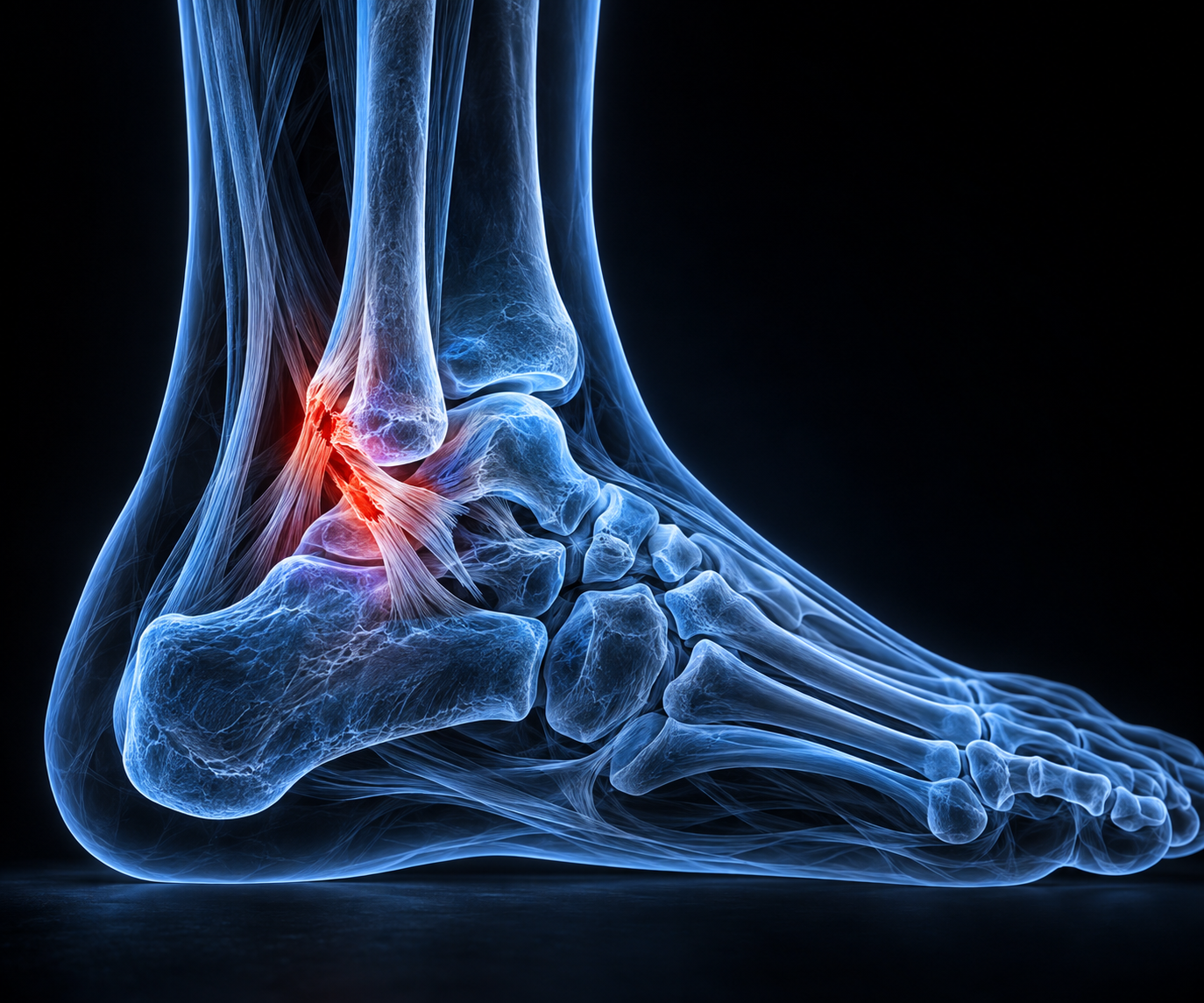
The lateral ankle ligaments — primarily the anterior talofibular ligament (ATFL) and calcaneofibular ligament (CFL) — contain mechanoreceptors that contribute to proprioception and the reflexive peroneal muscle activation that protects the ankle during sudden inversion movements. When these ligaments are sprained, the mechanoreceptor network is disrupted — and that disruption affects the ankle's ability to sense and respond to inversion stress at the speed that sport demands. Research has found that peroneal muscle reaction time is measurably slower in athletes with ankle instability than in uninjured controls — a deficit that manifests not as pain during a test but as the fraction-of-a-second delay in protective muscle activation during a plant-and-cut that determines whether the ankle stays intact or rolls again.
The Long-Term Consequences
Left unaddressed, chronic ankle instability doesn't simply produce repeated sprains. Research has linked it to progressive cartilage damage and a significantly elevated risk of posttraumatic osteoarthritis of the ankle joint — a long-term consequence that is almost never mentioned in sideline discussions about when an athlete can return to practice. A 2025 publication noted that ankle sprains carry a substantial risk of developing chronic instability and long-term complications including posttraumatic osteoarthritis — outcomes that trace directly back to the quality of the initial management and return-to-sport decision making.
03 | What Criteria-Based Return to Sport Evaluates
A criteria-based return-to-sport framework for ankle sprain assesses the functional qualities that time-based clearance ignores. The goal is to determine whether the ankle can handle the mechanical and neuromuscular demands of sport before it's exposed to them — not to confirm that enough days have passed.
The Three-Phase Return Framework
Current return-to-sport guidelines propose a three-phase progression that maps more precisely onto what the ankle actually needs to demonstrate before full clearance:
- Return to participation — Pain-free weight-bearing, full passive range of motion, ability to perform low-intensity straight-line activity without guarding or compensation. This is the minimum threshold for rejoining the training environment, not for unrestricted play.
- Return to sport — Functional testing passed across the criteria below; ability to perform sport-specific movement patterns at submaximal intensity without pain or instability.
- Return to performance — Full unrestricted competition at the athlete's preinjury level, confirmed by objective testing symmetry and subjective confidence in the ankle.
Key Functional Testing Criteria
| Assessment | What It Tests | Why It Matters |
|---|---|---|
| Dorsiflexion range of motion | Weight-bearing lunge test — symmetry with uninjured side | Restricted dorsiflexion alters landing and cutting mechanics and increases ankle sprain recurrence risk |
| Single-leg balance | Eyes open and closed; time and sway on injured vs. uninjured limb | Postural control deficits persist after sprain and directly contribute to re-injury risk during dynamic sport |
| Single-leg hop tests | Single hop, triple hop, crossover hop — limb symmetry index vs. contralateral | Functional power and dynamic ankle stability under load; one of the most discriminating tests for return readiness |
| Peroneal muscle strength | Eversion strength vs. contralateral; ideally under dynamic weight-bearing conditions | Evertor strength is the primary active protection against inversion injury; deficits are common and frequently missed |
| Sport-specific movement quality | Cutting, lateral shuffles, jump landing mechanics at progressive intensity | The movement demands of return to sport require progressive exposure, not an assumption that straight-line function translates |
| Psychological readiness | Fear of re-injury questionnaire (e.g. Ankle-GO, ALR-RSI scale) | Fear of re-injury is independently associated with worse outcomes and reduced performance after ankle sprain — it's a measurable clinical variable, not a personality trait |
The Psychological Readiness Component
One of the more significant developments in ankle sprain return-to-sport research is the recognition that psychological readiness — specifically fear of re-injury and confidence in the ankle — is a meaningful, measurable predictor of outcomes after lateral ankle sprain. Athletes who return to sport with high fear-of-re-injury scores demonstrate altered movement patterns, reduced performance, and higher rates of subsequent injury than those who return with full confidence in the limb. The Ankle Ligament Reconstruction-Return to Sport after Injury (ALR-RSI) questionnaire and the Ankle-GO score both incorporate psychological readiness alongside functional testing — a recognition that the decision to return an athlete is incomplete without it.
04 | Grade-Based Return Timelines — With the Caveat That Criteria Matter More Than Dates
Timelines for ankle sprain return are useful as a rough framework for planning — but they should be understood as the earliest window in which criteria might be met, not as clearance dates in themselves.
| Grade | Injury Description | Typical Symptom Timeline | Criteria-Based Return Window |
|---|---|---|---|
| Grade 1 | Microscopic ligament tearing; no instability; minimal swelling | Pain and swelling resolve in days | 3–7 days — when functional criteria are met, not when pain resolves |
| Grade 2 | Partial ligament tear; some instability; moderate swelling and bruising | Symptom resolution in 1–3 weeks | 2–6 weeks — progressive loading and functional testing before cutting sports |
| Grade 3 | Complete ligament rupture; significant instability; marked swelling | Symptoms may persist for weeks | 6–12 weeks — full criteria-based clearance required before any cutting or pivoting activity |
The most dangerous grade for premature return is Grade 2 — partial tears that resolve symptomatically faster than the neuromuscular system recovers. A Grade 2 sprain that feels functional at 10 days may still have significant proprioceptive and evertor strength deficits that aren't apparent during walking but become consequential the moment the athlete is asked to plant and cut at full speed.
05 | Putting This Into Practice
- Pain-free walking is not the return-to-sport threshold. It's the threshold for advancing to the next phase of rehabilitation. Sport requires cutting, landing, and change of direction at speeds that walking doesn't test — and the deficits that lead to re-injury are often invisible until the ankle is challenged at those speeds.
- Assess your dorsiflexion range on both sides before returning to full activity. A deficit of more than 5 degrees compared to the uninjured ankle is a measurable functional limitation that warrants continued rehabilitation.
- Single-leg balance and hopping symmetry are the most practical self-assessments available outside a clinical setting. If you can't balance on the injured ankle as long as the uninjured one with eyes closed, or if your single-leg hop distance is noticeably shorter on the injured side, the neuromuscular system hasn't finished recovering.
- Acknowledge fear of re-injury as a clinical variable, not a mental weakness. Athletes who return with high levels of movement apprehension after ankle sprain have measurably worse outcomes — addressing confidence in the ankle is part of the return-to-sport process, not an afterthought.
- Replace "how many days has it been?" with "what can the ankle do?" as the primary return-to-sport question. The research is consistent that time elapsed is an insufficient criterion for clearance — functional testing is what actually predicts whether an athlete is ready for sport demands.
- Grade 2 ankle sprains in particular warrant careful management. The symptom timeline is deceptively short, and the window between feeling ready and being ready is where most recurrences happen.
- Understand that 40% chronic instability development is not inevitable — it's the outcome of inadequate return-to-sport management. Athletes who go through a full criteria-based return process have significantly better long-term outcomes than those cleared on time alone.
- Take the long-term consequence seriously. Recurrent ankle sprains from chronic instability are linked to progressive cartilage damage and early-onset ankle osteoarthritis — a long-term cost that makes the extra week or two of criteria-based clearance worthwhile.
The ankle sprain is common enough that it's easy to dismiss — a few days off, some ice, back on the field. That approach produces the 40% chronic instability rate the research consistently documents. Criteria-based return doesn't require a laboratory or sophisticated equipment. It requires functional testing, a progressive return framework, and the discipline to clear an athlete based on what the ankle can demonstrate rather than how many days have passed.
Dealing With an Ankle Sprain or Recurring Ankle Instability?
At KRU Physical Therapy + Performance Lab, we assess ankle function, identify neuromuscular deficits, and guide athletes through criteria-based return-to-sport progressions that reduce re-injury risk and address the instability patterns that lead to chronic ankle problems. Two locations across South Florida, plus telehealth worldwide.
References
- Doherty C, Bleakley C, Hertel J, et al. Recovery From a First-Time Lateral Ankle Sprain and the Predictors of Chronic Ankle Instability. Am J Sports Med. 2016. (40% CAI development rate.)
- Which Functional Tests and Self-Reported Questionnaires Can Help Clinicians Make Valid Return to Sport Decisions in Patients With Chronic Ankle Instability? A Narrative Review and Expert Opinion. PMC. 2022. (Coper/non-coper distinction; FAAM and ALR-RSI; no objective criteria consensus.)
- Towards the Strategies of Return to Sport After Lateral Ankle Sprain: A Systematic Review. Annals of Medicine. 2025. (Three-phase RTS framework; multifaceted and interdisciplinary.)
- Lack of Consensus on Return to Sport Criteria Following Lateral Ankle Sprain: A Systematic Review of Expert Opinions. 2019. (Lack of validated criteria beyond time-based parameters; Ankle-GO development.)
- Hardy A, et al. Use of Ankle-GO to Assess and Predict Return to Sport After Lateral Ankle Reconstruction for Chronic Ankle Instability. Orthop J Sports Med. 2025. (20–40% CAI from inappropriate management or premature RTS; Ankle-GO validity.)
- Bleakley CM. Rehabilitation and Return to Sports of Ankle Injuries. In: Espregueira-Mendes J, et al. (eds.) Orthopaedic Sports Medicine. Springer. 2025. (Posttraumatic osteoarthritis; functional management; progressive loading.)
- Herzog MM, et al. Incidence of acute lateral ankle sprain in the United States. Orthop J Sports Med. 2019. (2.1–3.2 per 1,000 person-years; most common sports injury.)
- Peroneal muscle reaction time and proprioception in chronic ankle instability — systematic review. Various authors. (Slowed peroneal response time; mechanoreceptor disruption.)
- In vivo cartilage contact strains in patients with lateral ankle instability. Cited in Bleakley 2025. (Progressive cartilage damage in CAI.)